

ISAAA Inc. and DA-BPO Organize Reel-Making Competition on Agri-Biotech Applications
| |
The International Service for the Acquisition of Agri-biotech Applications, Inc. (ISAAA Inc.), in partnership with the Department of Agriculture - Biotech Program Office (DA BPO), held a webinar on August 18, 2026, to officially launch Biotech for Reel: Reel-Making Competition on Agri-Biotech Applications.
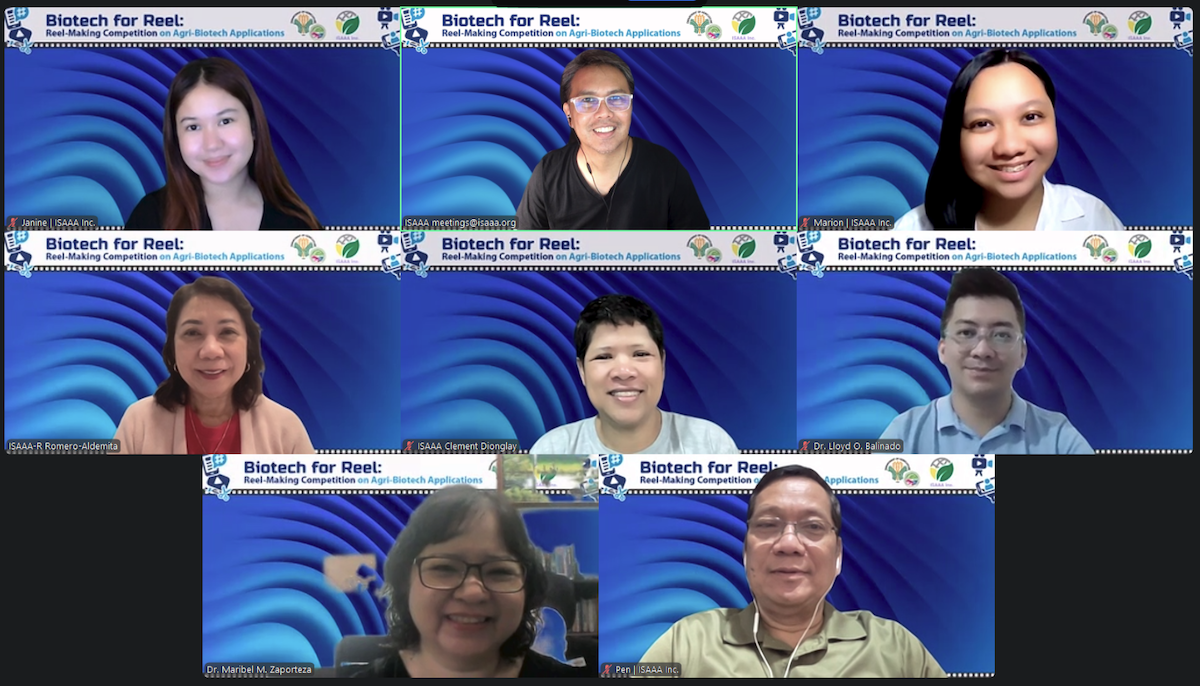
Through the collaborative Know the Science project under the Philippine Agriculture and Fisheries Biotechnology Program (DA Biotech Program), Biotech for Reel encourages students, educators, and aspiring content creators to produce short-form videos (reels) highlighting the applications and relevance of agri-biotechnology in everyday life. The competition aims to strengthen participants' science communication skills while generating digital content that promotes greater public appreciation and understanding of biotechnology.
To kick off the competition, the webinar featured two key presentations to give an overview of biotechnology and its applications in various sectors and to introduce participants to the fundamentals of science content creation. It then encouraged participants to apply their knowledge and creativity by joining the competition and to take part in the celebration of the 2026 National Biotechnology Week (NBW) on September 21-24, 2026.
Dr. Rhodora Romero-Aldemita, Executive Director of ISAAA Inc., welcomed participants and highlighted the intersection of science and digital media. According to Dr. Aldemita, while biotechnology strengthens food security, protects the environment, and improves daily lives, many of its contributions work quietly in the background. To bring these contributions to light, biotechnology must be communicated in ways that are accurate, engaging, and accessible.
“Content creators hold the power to shape public perception. They influence mindsets and drive digital conversations,” said Dr. Aldemita. “While producing catchy and engaging reels that promote biotechnology is our goal, being responsible digital storytellers is our duty.” She emphasized that every video should be grounded in facts and backed by science.
Dr. Maribel Zaporteza, Assistant Professor at the Institute of Biological Sciences at the University of the Philippines Los Baños (UPLB), discussed how biotechnology is present in everyday life, from food production, agriculture, medicine, industrial settings, and environmental protection. “We are exposed to them, but because we are always seeing them around us, sometimes we take them for granted,” Dr. Zaporteza said. She also discussed the evolution of biological innovation from traditional methods to modern biotechnology and emerging innovations addressing global challenges.
Dr. Lloyd Balinado, Associate Professor and Director of the Knowledge Management Center at Cavite State University, shared practical tips for creating engaging science content. “Some of the most impactful science communication today is done with nothing more than a smartphone and a laboratory specimen. So your focus here shouldn't be on the gear but rather on the content.” He emphasized that rather than simply presenting biotechnology facts, reels should show science in action. He also introduced a framework combining the hook, value, visuals, personality, and action to make technical biotechnology concepts more interesting and understandable.
The Q&A session was moderated by Mr. Panfilo de Guzman, Deputy Director and former Senior Associate Scientist at ISAAA Inc. Discussions covered the safety and benefits of biotechnology, tips for producing effective reels, and the role of short-form content in bridging knowledge gaps on biotechnology applications, especially among farmers.
The webinar recording and presentation materials are available on the ISAAA website for participants’ reference.
The organizers received over 200 entries. Winners will be announced during National Biotechnology Week and will receive cash prizes.
About ISAAA
The International Service for the Acquisition of Agri-biotech Applications, Inc. (ISAAA, Inc.) is a non-profit international organization that advances biotechnology knowledge by supporting transformative technologies, fostering impactful partnerships, and facilitating the development of science-based policies for food-secure communities.
Media Contact
Janine Escasura
jescasura@isaaa.org
www.isaaa.org/
| Archive | Older Post |
Science Speaks is ISAAA Inc.'s official blog. Weekly blog articles, authored by ISAAA writers, partners, and invited contributors, aim to help share, disseminate, and promote scientific knowledge and its vital role in achieving global agricultural sustainability and development. Your support to Science Speaks will help us achieve this goal. You can help us by donating as little as $10.