

Global Developments on Regulatory Frameworks and Possible Harmonization
| |
The world is facing a polycrisis that affects the economic, environmental, geopolitical, societal, and technological areas of life, slowing down the achievement of the United Nations (UN) Sustainable Development Goal (SDG) 2 to "End hunger, achieve food security and improved nutrition, and promote sustainable agriculture." The Food and Agriculture Organization of the United Nations (FAO) reports that food production must be increased by 70% to feed the growing population, which will reach 9.5 billion by 2050.1, 2
The generation of genetic variation is an essential component of crop and animal breeding for developing new traits or combinations of traits that address farming problems and meet consumer needs. This can be achieved through conventional breeding of the same species and unrelated varieties. This is followed by more than 10 years of selection and identification of stable lines, which are tested across different locations and seasons before being nominated for registration.
The use of conventional agriculture takes years to develop new varieties that will provide sufficient food. In the past, recorded famines and poverty have resulted in chaos and instability, prompting the FAO to call for significant additional efforts, as the “business as usual” approach appears neither promising nor sustainable.3
In the last three decades, genetic engineering (GE) or genetic modification (GM) has generated DNA-based variations by introducing genes from related and unrelated species. Crop genetic engineering is considered the fastest-adopted agricultural technology. By 2024, a total of 73 countries had commercialized biotech/GM crops: 44 engaged in domestic cultivation and 29 through importation. In over 28 years, 3.75 billion hectares of improved crops have been planted, a manifestation of long-term trust and confidence in the technology’s safety and efficacy.4
While some countries are able to commercialize GM crops, other nations face hurdles such as acceptance, strict and complicated regulatory frameworks, political challenges, and court cases, to name a few. Moreover, public and private technology developers face a costly regulatory path, delaying the delivery of improved biotech products to farmers’ hands.
The advent of gene editing (GEd), a technology that can generate specific, site-directed DNA insertions, deletions, and substitutions, could be the solution to expedite the generation of variation in a less costly and more efficient way. Scientific information on gene editing remains limited, creating confusion about the regulation of GEd products. This white paper aims to provide some insights on how countries regulate GEd, including the unique features and recommended best practices to raise awareness, understanding, and acceptance of GEd and its products.
Global Overview of Gene Editing Regulations
Current global regulations are guided by the following categories of targeted editing methods: site-directed nuclease 1 (SDN-1) does not contain any foreign nucleotide sequence; SDN-2 may contain small insertions or deletions with a donor template; and SDN-3 large inserts with multiple genes. SDN-1 and SDN-2 are often classified as non-GMO in many countries, while SDN-3 is considered GMO.5
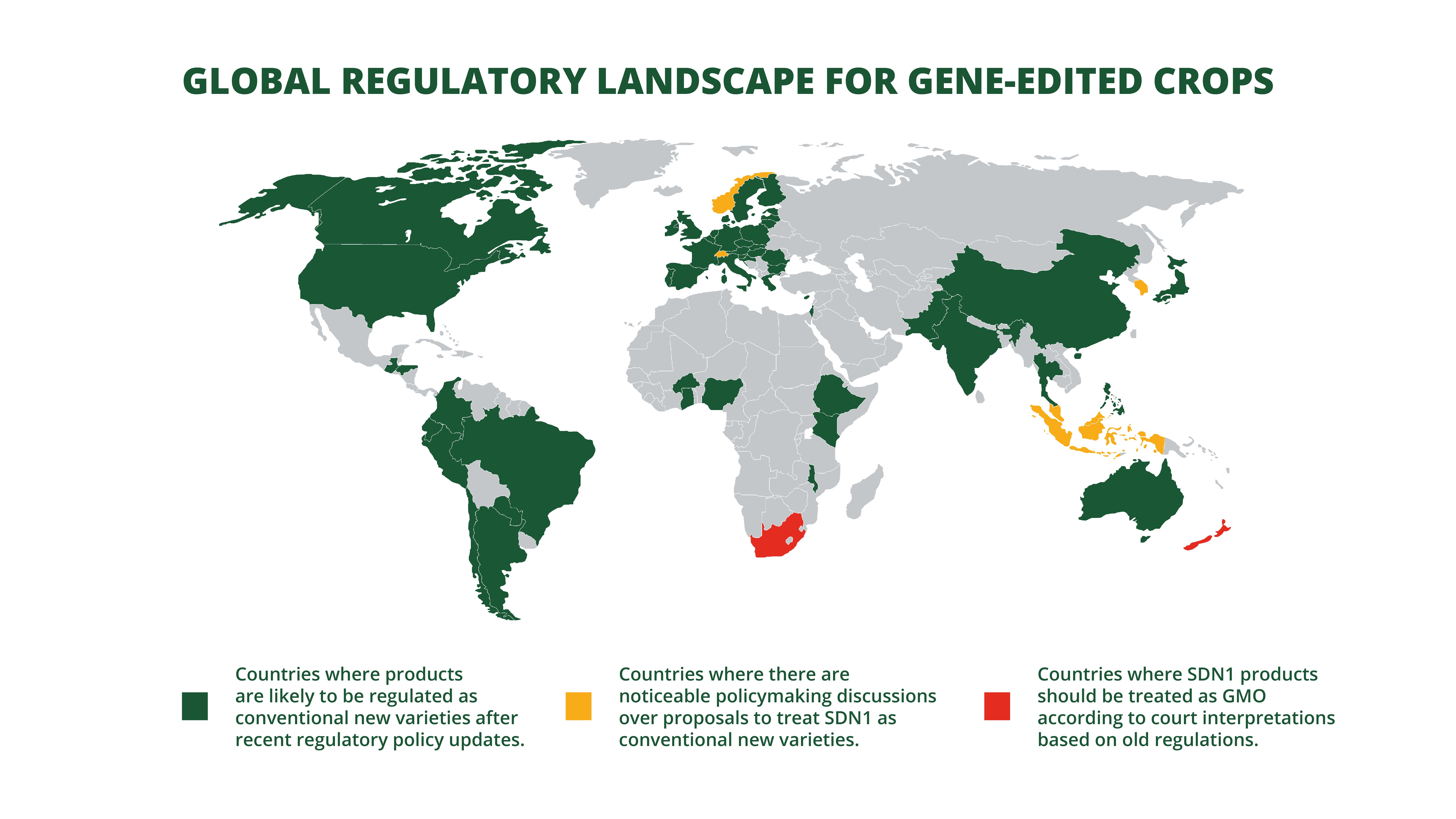
Argentina was the first country to enforce the “no foreign DNA” product-based approach in 2015 (equivalent to SDN-1) and is widely referenced by other regulators. In Asia, countries including Japan, India, China, Pakistan, the Philippines, and Thailand follow the same regulatory principle. Determinations that gene-edited crops are non-GM have been issued for some crops and animals in the Philippines and Japan. Australia and New Zealand are revising their regulations to address advancements in gene editing in crops and animals.5, 6
A similar regulatory principle is being followed for planting and commercialization of gene-edited products in North America (United States and Canada) and South America (Brazil, Chile, Paraguay, Uruguay, Colombia, Honduras, and Guatemala).5 African countries including Nigeria, Kenya, Malawi, and Ghana follow the same regulatory principle. Botswana, Benin, Eswatini, Ethiopia, Mozambique, Uganda, South Africa, and Zambia are developing their own regulatory frameworks for crop gene editing.5, 7
In Europe, the United Kingdom’s new rules on gene-editing and other precision-targeted approaches are deemed less risky than GMOs. Following this, the country approved the first gene-edited crop, barley, which has higher lipid content in the plant tissues for livestock feed and has the potential to reduce methane emissions.8 Recent developments in Europe categorized gene-edited plants as NGT1, which have small targeted genetic changes (up to 20 nucleosides) and are treated like conventionally bred plants and thus exempted from GMO regulations. Other gene-edited plants will be treated as GMOs and will be submitted to risk assessment and authorization procedures.9
Trade of Gene-edited Produce
Global trade of gene-edited produce will be possible if trading countries have existing regulatory policies that are aligned and follow the same principle. This is exemplified by the ongoing trade between the United States and Canada. Countries in Latin America, including Argentina, Brazil, Chile, Paraguay, and Uruguay, have their own gene editing agreements that facilitate trade of gene-edited seeds in the region. Japan started selling gene-edited crops, such as high-GABA tomatoes. With UK’s gene editing regulations and the newly established EU policies, trade could commence soon.
Achieving Regulatory Alignment of Gene-edited Products
Farmer and consumer access to gene-edited products will be stalled if countries have regulatory policies that are fragmented, vague, and unpredictable. This will also have a negative impact on innovation, hindering the development of seeds that could address climate change and food wastage and help achieve food and environmental sustainability.
With the current scientific understanding of gene editing and conventional breeding, the following points should be considered in crafting regulatory policies on gene editing:
- Gene-edited products that do not contain foreign DNA after deletion, small-segment insertion, and substitutions should be considered conventional.
- Gene-edited plants that are indistinguishable from conventionally bred ones and do not contain stable foreign DNA should not be regulated as GMOs.
- Irregularities in the regulatory system applying different rules, timelines, and definitions slow down the release of gene-edited seeds to farmers and improved products to consumers.
- Trading countries must find ways to collaborate and align their policies to support seed trade, even without existing harmonization.
- A predictable trade path for gene-edited plant products depends on stable regulatory policies that encourage breeders’ innovations that should reach markets in a realistic timeframe.
- Farmers and consumers must be continually informed of gene-edited products in the market, including their traits, benefits, and contributions to the economy.
Conclusion
Gene editing technology has been delivering improved products that contribute to food security and environmental sustainability, and provide solutions to many agricultural and climate change-related problems. Access to gene-edited products may be hindered if regulatory policies are not in place, are confusing, and unpredictable. The role of the government is to understand the science in consultation with research institutions and craft enabling policies that will support adoption of gene-edited products. Existing local country policies should be streamlined to reduce complications in developing the national policy. Lastly, there should be mutual understanding among the stakeholders involved in policy-making, research, and trade, in order to have a working policy about gene-edited plants and products.
References
- World Economic Forum. 2023. We’re on the brink of a ‘polycrisis’ - how worried should we be. https://www.weforum.org/stories/2023/01/polycrisis-global-risks-report-cost-of-living/
- United Nations Sustainable Development Goals. 2025. The Sustainable Development Goals Report 2025. https://unstats.un.org/sdgs/report/2025/
- Food and Agriculture Organization of the United Nations Rome, 2022. The future of food and agriculture Drivers and triggers for transformation https://openknowledge.fao.org/server/api/core/bitstreams/002ef5c5-3501-413f-b226-c87da30a7a29/content
- ISAAA. 2024. Global Status of Commercialized Biotech/GM Crops in 2024. ISAAA Brief No. 57. ISAAA: Los Baños, Laguna, Philippines.
- Michael G. K. Jones. 2022. Enabling Trade in Gene-Edited Produce in Asia and Australasia: The Developing Regulatory Landscape and Future Perspectives. Plants 2022. 11(19), 2538; https://doi.org/10.3390/plants11192538. https://www.mdpi.com/2223-7747/11/19/2538
- ISAAA Science Speaks. 2024. Updates on Global Regulatory Landscape for Gene-Edited Crops https://www.isaaa.org/blog/entry/default.asp?BlogDate=1/24/2024
- Tilahun Rabuma et al. 2024. Navigating biosafety regulatory frameworks for genetic engineering in Africa: A focus on genome editing and gene drive technologies. Front Bioeng Biotechnol 2024 Oct 24;12:1483279. doi: 10.3389/fbioe.2024.1483279 https://pmc.ncbi.nlm.nih.gov/articles/PMC11540646/table/T2/
- ISAAA Science Speaks. June 3, 2026. Rothamsted's Gene-Edited Barley Becomes First Crop to Receive the UK's Precision Bred Organism Marketing Notice. https://www.isaaa.org/kc/cropbiotechupdate/article/default.asp?ID=21747
- ISAAA Science Speaks. May 28, 2026. Precaution vs. Progress: The Final Countdown for Europe’s NGT Proposal https://www.isaaa.org/blog/entry/default.asp?BlogDate=5/28/2026
| Newer Post | Archive | Older Post |
Science Speaks is ISAAA Inc.'s official blog. Weekly blog articles, authored by ISAAA writers, partners, and invited contributors, aim to help share, disseminate, and promote scientific knowledge and its vital role in achieving global agricultural sustainability and development. Your support to Science Speaks will help us achieve this goal. You can help us by donating as little as $10.