In This
Issue:
EP APPROVES
TRACING/LABELING SYSTEM FOR GMOS
The
European Parliament adopted its second reading on two genetically
modified organism (GMO) Commission papers, which consolidates a
trustworthy and safe approach to GMOs, GM food and GM feed. These
papers establish a system for the tracing and labeling of GM food
and feed products, and its placing on the markets in the EU. The
EU system would also cover those GM products which have been derived
from GMOs. This system also ensures the full traceability of GMOs
throughout the chain - that is from farm to fork.
According
to Margot Wallstrom, Environment Commissioner, the full implementation
of the EU legislation on GMOs reinforces its (EU's) international
credibility and could help in building public confidence in new
technologies. Similarly, Health and Consumer Protection Commissioner
David Bryne states "consumers will also have a clear choice
of products to buy as GM food will now be clearly labeled. For
the first time, farmers will see labels on GM feed. Europe will
now have a comprehensive and transparent system of authorization
and labeling that can only enhance business and consumer confidence."
Some
of the provisions of the new law are as follows:
- When
using or handling GM products, business operators are required
to transmit and retain information at each stage of placing on
the market. Information on the presence of GMOs in products must
be transmitted throughout the entire chain and retained for five
years. Industry must ensure that all systems are in place.
- All
foods produced from GMOs, irrespective of whether there is DNA
or protein of GM origin in the final product, will now be labeled.
- Current
labeling requirements will now cover all food (such as soya or
maize oil produced from GM soya or GM maize) and food ingredients
produced from GMOs (such as biscuits with maize oil produced
from GM maize).
- GM
feed will be labeled in accordance with the laws applied to GM
food.
- The
presence of GM material in conventional food need not be labeled
if it is below 0.9%.
- Adventitious
GM materials should not exceed the threshold set at 0.5% unless
the operator can demonstrate that its presence was unavoidable.
Related
articles can be downloaded at http://europa.eu.int/rapid/start/cgi/
guesten.ksh?p_action.gettxt=gt&doc=IP/03/935|0|RAPID&lg=EN&display
and http://www2.europarl.eu.int/omk/sipade2?PROG=PRESS&XSL=PRESS-NEWS&L=EN&REFERER=$nt$/press/Index_en.htm
In related
developments, Associated Press reports that the Bush administration
believes that biotech food label requirements approved by the European
Parliament are onerous, and has not changed its view that an illegal
ban is still in place.
The
new requirements will end a five-year moratorium on the introduction
of new genetically engineered foods but US officials say that the
proposed traceability and labeling does not meet US feasibility
standards.
BORLAUG: AGRIC
TECH TO FEED DEVELOPING WORLD
Nobel
Peace Laureate Norman Borlaug said that the 21st Century challenge
to agriculture is producing enough food to sustain the world's
continued population growth. "The world has the technology,
either available or well-advanced in the research pipeline, to
feed 10 billion people. Extending the Green Revolution to the Gene
Revolution will provide a better diet at lower prices to many more
food-insecure people," he added.
Borlaug
gave a keynote address at the Ministerial Conference and Expo on
Agricultural Science and Technology held recently in Sacramento,
California. He stressed that agricultural scientists can meet this
challenge through continued research and development of technology,
including biotechnology. However, he noted that some organizations
that influence public policy are impeding research due to unfounded
fears. For example, he noted that regulations constrain innovation
especially in smaller laboratories, and that the World Bank and
many bilateral donors have decreased support for public led research.
Borlaug also questioned the rapid consolidation of ownership of
life sciences companies and the current intellectual property system.
The
Nobel Laureate likewise focused on Africa which he says remains
the region of greatest concern. Africa's problems like declining
soil fertility and sparse application of improved technology, coupled
with the lack of roads and transport, poor education and health
services, and high population growth has led to continued chronic
hunger which portends an unprecedented humanitarian crisis.
For
additional information on the Ministerial Conference, visit: http://www.usda.gov.
MEXICO ACTION
SUMMIT'S "CALL TO ACTION"
About
200 participants from both public and private sectors who attended
the Mexico Action Summit in Mexico City from 2-3 June 2003 came
up with an action plan for cooperation between business, governments,
multilateral institutions and civil society from developing and
developed countries.
The
Summit was part of the continuing global momentum for sustainable
development where participants explored how increased food production
to feed the rural poor can be made compatible with natural resource
management and biodiversity stewardship.
Pedro
Sanchez, World Food Prize Laureate 2002, presented the draft Call
to Action. The Call included elements on:
- The
need for G8 leaders to act now to decisively address hunger and
poverty and to protect and restore the world's natural environment
for future generations;
- The
need for the Millennium Development Goals be the framework that
unites all public and private action;
- The
need for new approaches to working together in the policy arena
and in the scale-up of ecologically responsible and socially
productive agriculture, with the aim of promoting linkages between
agriculture, biodiversity and poverty elimination;
- The
need to restore agriculture as the priority sector in national
and international public policies; and
- The
need to eliminate subsidies on agricultural products and to adequately
value and promote health ecological systems that provide the
basis for agricultural production and a well-nourished population.
The
full report on the Mexico Summit is available online at http://www.iisd.ca/linkages/sd/sdmex/sdvol86num1.html
MCGLOUGHLIN: AG-BIOTECH FOR DEVELOPING COUNTRIES
"Biotechnology
is one tool which has a great impact on plant agriculture in the
developing world. Let us not throw away the technology merely because
of philosophical issues," says Dr. Martina Newell-McGloughlin,
Director of the University of California System wide Biotechnology
Research and Education Program. Speaking before a multi-sectoral
audience in Manila, Philippines, she shared her insights on "Agricultural
biotechnology: Benefits and questions today, potential and challenges
tomorrow."
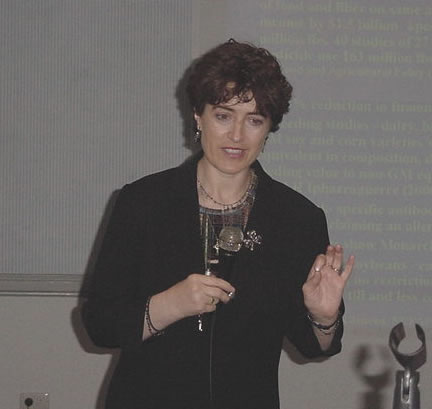
McGloughlin
noted that the tools of biotechnology can be used to improve texture,
color, flavor, growing season, stress tolerance, yield, geographical
distribution, disease resistance, shelf-life and other properties
of production crops. "The ability to manipulate plant nutritional
content heralds an exciting new era and has the potential to directly
benefit consumers and have a positive impact in developing countries," she
added. Examples of GM crops that have great potential for these
countries include Bt corn which reduces toxic fungi, GM rice with
increased beta carotene, delayed ripened fruits like papaya and
mango, and plant vaccines.
The
internationally recognized authority on biotechnology said that
the belief that genetically modified foods pose new or greater
dangers to the environment or human health are "neither supported
by the weight of scientific research nor by a great majority of
the scientific community. Millions of people have already eaten
the products of agricultural biotechnology and no adverse effects
have been demonstrated".
McGloughlin
likewise emphasized that from conception to commercial introduction,
it can take up to 10 years to bring a biotech plant to the market;
pass through ten separate regulatory procedures, and six separate
opportunities for the public to review and comment on the regulatory
process. After commercialization, the regulatory agencies still
have the power to demand immediate market removal of any product
feared to have unreasonable safety risks.
She
concluded by saying that "we should not limit the wonderful
potential of improved nutrition and quality that promise to strengthen
the agricultural economies in the world."
CONSUMERS INTERNATIONAL FAVORS CODEX'S MOVE
The
Codex Alimentarius Commission, a food standards agency which is
a joint effort of the UN World Health Organization and the UN Food
and Agriculture Organization, adopted three sets of standards on
the safe regulations of GMOs. Consumer International sees this
move of Codex as strengthening EU countries that opt for established
regulatory systems concerning GMOs.
"These
standards are a tremendous victory for consumers, for science,
for good regulation and for common sense," says Julian Edwards,
Director-General of Consumers International, which represents more
than 250 organizations in 110 countries.
These
three documents provide guidelines for the safe assessment of GM
crops (such as maize, corn, soybeans) and GM microorganisms. Provisions
were given in cases when GM food may contain new toxins or allergens,
is altered nutritionally, or exhibits unexpected effects.
"Product
tracing " was also endorsed as a tool for risk management,
and a baseline standard, which ensures that GMOs are "as safe
as their conventional counterpart," was established.
The
three documents further addressed several key controversies about
GM food, such as 1. the transfer of genes from commonly allergenic
foods (e.g., peanuts), and 2. antibiotic resistance marker genes
in GMOs that could create resistance to "clinically used" antibiotics.
See
Consumers International's press release at http://www.consumersinternational.org/news/display.asp?
regionid=135&tag=C&id=261&type=news&cat=465&langid=1
CLIMATE CHANGE WILL
DECREASE CORN PRODUCTION
Scientists
of the International Center for Tropical Agriculture (CIAT) and
the International Livestock Research Institute (ILRI) predict that
climate change could potentially lead to a 10 percent drop in developing-country
corn production over the next 50 years. Researchers Peter Jones
and Philip Thorton of CIAT and ILRI, respectively, forecast possible
annual losses of up to 10 million tons in a worst-case scenario.
The
team's findings were based from weather simulations from a computer
model called "MarkSim". In a report published in the
journal Global Environmental Change, the researchers predict that
countries such as Brazil and Mexico will be greatly affected and
that, overall, Latin America would see a 25 percent reduction in
corn production due to higher temperatures and decreasing rainfall.
About 20 percent decrease in production will be experienced by
Africa.
"The
message to be derived from the data, however, is that there will
be many places where yield reductions can be handled by new varieties
or agricultural practices, some where yields will increase due
to climate change, and still others where crops will effectively
no longer grow," said Jones.
The
CIAT researcher adds that their ultimate objective is "to
arm the poorest and most vulnerable members of society with coping
strategies geared to their locations. If we can provide quality
information on local climate effects and encourage policymakers
to act on this information, farmers will likely suffer less from
crop losses due to climate change."
For
more information, visit http://www.futureharvest.org/news/maize_model.shtml or
email Peter Jones at p.jones@cgiar.org
GM POTATO TO REDUCE FUNGICIDE COST IN EUROPE
Successful
introduction of a genetically modified potato, particularly late
blight resistant potato, on 100 percent of European potato acreage
would eliminate the need for European Union growers to use 7.5
million kilograms of fungicides, thus reducing production costs
by (375 million and increasing potato production by 858 million
kilograms worth (99 million. This is the forecast of Leonard Gianessi
and colleagues in their case study entitled "Plant Biotechnology:
Potential Impact for Improving Pest Management in European Agriculture:
Potato Case Study."
One
of a series of case studies recently completed by the National
Center for Food and Agricultural Policy, Washington, DC, the potato
case study provides a summary of the potential impacts of Bt potato
in Europe.
The
research team cited a University of Idaho study that estimated
the potential benefit of GM late blight resistant potato in Europe.
It estimated that planting it would reduce fungicide cost by $136/ha
in Europe or a reduction in 25 million kilograms of fungicide.
The average benefit for Europe was $212/hectare which includes
yield increases, reduction in storage rots, improved quality, and
reduced fungicide cost.
The
full report is available online at http://www.ncfap.org/reports/Europe/Potato.pdf
INNOVATIVE BIOTECH
POLICY FOR AFRICA
"There
is enormous potential in bio-pharmacy in Africa, in vaccine production,
in application to indigenous foods, in improving yields in raw
materials such as cotton. But before biotechnology can realize
its potential in Africa, governments must invest in an innovative
biotechnology policy that enables them to make intelligent choices
that would not depend on what the Green Peace movement wants or
what the European Union advocates or what the biotechnology entrepreneurs
are pushing from America. Rather, it will depend on the needs and
aspirations of the peoples of Africa, their social, cultural and
environmental concerns." This statement was expressed by Dr.
Osita Ogbu, executive director of the African Technology Policy
Studies Network (ATPSN) during the Scientific Revival Day in Africa
in Nairobi, Kenya. June 30 of every year has been declared by African
leaders as a day to appreciate what science can do for the continent.
The
ATPSN executive director also said that Africa must invest and
build adequate national or regional capacity for biotechnology
including appropriate institutions to ensure the use of the technology. "To
be part of this scientific revolution, we need knowledge: requisite
and organized knowledge that empowers," he added./Kenya Biotechnology
Information Centre
For
more on Kenya Biotechnology Information Centre visit http://www.isaaa-africenter.org
BIOTECH ADOPTION INCREASES IN US
The
United States Department of Agriculture Acreage Report states that
adoption of biotech varieties continues to increase. About 40 percent
of this year's corn crop will be planted to biotech varieties,
up from 34% in 2002. In South Dakota, 75 percent of all corn planted
will be biotech. Insect resistant varieties will account for 25
percent of the crop, up from 22 percent last year, and herbicide
resistant varieties will reach 11 percent.
Biotech
soybean varieties will account for 81 percent of this year's crop,
up from 75 percent in 2002. More than 90 percent of the crop in
South Dakota will be biotech. About 73 percent of cotton will be
GM varieties, or about 2 percent more than in 2002.
More
details on the acreage report at http://www.cropdecisions.com/show_story.php?id=20164.
For more on the USDA, visit http://www.usda.gov.
INDIA-US BIOTECH
PARTNERSHIP
India
and the United States will soon set up a formal framework for research
collaboration in the field of agricultural biotechnology. Under
the agreement, the Indian Department of Biotechnology (DBT) and
the US Agency for International Development (USAID) will form consortium-based
partnerships in areas such as policy planning, research and development,
and capacity building.
Research
collaboration between the two countries will dwell on the areas
of soil salinity, drought and nutritional improvement. Private-public
partnerships will also be promoted for the setting up of common
research facilities, the identification of possible research projects,
and the carrying out of detailed studies in functional genomics.
See
the full story at http://www.scidev.net/news/index.cfm?fuseaction=readnews&itemid=888&language=1
IITA TO WORK
ON CASSAVA MOSAIC DISEASE
The
International Institute for Tropical Agriculture (IITA) in Ibadan,
Nigeria is gearing efforts to stop the outbreak of virulent Cassava
Mosaic Disease (CMD) in Nigeria which could lead to food shortages
in the cassava belt of the country. Supporting the project are
the government of Nigeria, the Niger Delta Development Commission,
and the United States Agency for International Development.
IITA
reports that the two viruses, which are precursors to the most
destructive form of the disease, have already been found in the
cassava belt of Nigeria and IITA researchers believe that prompt
action is needed. In Nigeria, IITA plans to produce millions of
new disease-resistant cassava plantlets and cuttings for distribution
to Nigerian farmers.
The
improved plants will not only resist the disease but will also
slow its spread to nonresistant varieties, acting as a barrier.
CMD is often carried from plant to plant by white flies that feed
on the cassava leaves. The virus attacks the leaves, preventing
normal photosynthesis. As a consequence, the diseased plant stops
producing storage roots.
For
more information, email Dr. Alfred Dixon, IITA cassava breeder,
at a.Dixon@cgiar.org
ANNOUNCEMENTS:
NEW PUBLICATIONS
FROM ISAAA
The
Global Knowledge Center on Crop Biotechnology of the International
Service for the Acquisition of Agri-biotech Applications (ISAAA)
has made available on its website Pocket K No. 11 entitled "Contribution
of GM technology to the livestock sector." Pocket Ks are Pockets
of Knowledge on crop biotechnology products and related issues.
To view or download the publication and back issues, go to http://www.isaaa.org/kc.
"NCFAP
Study: Plant biotechnology has growth potential in Europe," is
ISAAA's latest K (Knowledge) Sheet. This K-Sheet summarizes the
results of the first three case studies released by the National
Center for Food and Agricultural Policy (NCFAP) which shows how
GM crops can benefit European farmers. Download the summary from http://www.isaaa.org/kc.
Q & A ON GMOS IN EUROPE
Questions
and answers fact sheet on the regulation of genetically modified
organisms in the European Union is now available in a 27-page document
at http://europa.eu.int/comm/dgs/health_consumer/
library/press/press298_en.pdf. It is divided into two
sections; Part A covers legislation in force; Part B focuses
on the legislative proposals on traceability and labeling
put forward in July 2001. | 

