In This
Issue:
PLANT
BIOTECH FOR DEVELOPING COUNTRIES
The
greatest benefits of plant biotechnology will be derived from the
adoption of improved crop varieties in the developing countries
of the world where billions of people still depend on agriculture
for their livelihoods. This is the conclusion of Gary Toenniessen,
John O'Toole and Joseph DeVries of the Rockefeller Foundation in
an article entitled "Advances in Plant Biotechnology and Its
Adoption in Developing Countries" published in Current Opinion
in Plant Biology (2003, 6:1-8).
"There
are already more farmers growing and benefiting from Bt cotton
in China than there are farmers in the USA", the Rockefeller
team said. They note that countries like China, India and Brazil
are building real capacity to generate plant biotechnologies and
are being incorporated into their national crop improvement programs.
Research
and development efforts where developing countries are now benefiting
from or have the potential to improve farmers' lives include: insect-resistant
Bt cotton, insect-resistant Bt cereals, disease resistance in rice
and cassava, control of Striga disease, drought tolerance, and
enhanced human nutrition.
Toenniessen
and colleagues note that these countries will have to put in place
intellectual property and regulatory policies that will assure
safety and encourage their private sector to develop and market
new crop varieties. In addition, they recommend that these countries
should empower public research institutions to continue doing research
and developing products that meet the needs of poor farmers and
consumers.
Visit http://www.current-opinion.com to
see this article.
EC: INTENSIFY EFFORTS
IN BIOTECH
The
European Commission (EC) has called on European member states to
exert urgent and decisive action and concrete commitments in the
life sciences and biotechnology. It said that diverging policies
among them could seriously hamper the effectiveness and consistency
of the EU strategy in these research areas.
While
the EU 6th Research Framework Programme and the EU regulatory framework
for GMOs are in place, Member States are still slow in adopting
biotechnology patents legislation.
European
Research Commissioner Philippe Busquin said that since legitimate
consumer and environmental concerns have been tackled by strict
EU legislation, it is time to reverse the downward trend for biotech
support. "If we do not react, we will be dependent on technology
developed elsewhere within the next ten years, he added.
Among
the initiatives that the EC has called for include:
- Better
coordinated research across Europe, access to finance and a clear
and effective intellectual property rights regime in Europe.
- Clearer
and predictable regulatory framework to tide the rapid decline
in GMO field research.
For
the full article, visit http://europa.eu.int/comm/biotechnology/introduction_en.html
BIOTECH IN ANIMAL
AGRICULTURE
The
US-based Council for Agricultural Science and Technology (CAST)
has come up with an issue paper on biotechnology in animal agriculture
which highlights its role in providing tangible benefits to society.
Written by a task force of nine scientists, the paper summarizes
existing and emerging technologies and assesses their current and
potential impacts.
Specific
to crop biotechnology is the discussion on the conservation of
the environment particularly on the impact of genetically modified
(GM) crops on animal manure management. GM crops are available
that decrease phosphorus excretion. For example, low-phytate, low-oligosaccharide
soybean has the potential to decrease further the excretion of
phosphorus by nonruminants. Through biotechnology, the phytase
gene has been inserted into alfalfa and canola to increase the
degradation of phytate which nonruminants are unable to do.
Another
area is GM crops that decrease nitrogen excretion. Biotech crops
with improved amino acid profiles have the potential to decrease
N excretion significantly, especially in nonruminants. The CAST
report says that increased levels of lysine, methionine, typtophan,
threonine, and other essential amino acids in grains mean that
the essential amino acid requirements of pigs and poultry can be
met with lower-protein diets that eventually must be degraded and
excreted in the urine. Feeding of low-protein diets results in
less production of ammonia and other volatile gases from manure
that diminish air quality and cause objectionable odors.
See
the article online at http://www.cast-science.org
THAI-FILIPINO FARMERS
VISIT BT CORN PLANTINGS
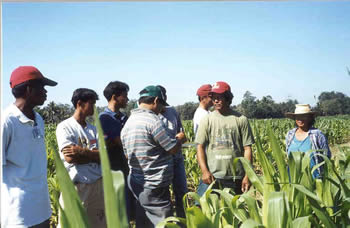
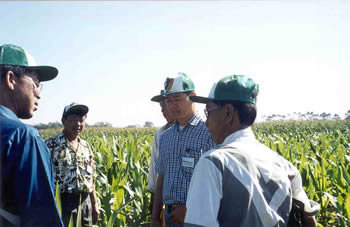
Thirteen
farmers from Thailand and the Philippines recently visited farms
planted to Bt corn in Luna, Isabela, Philippines. The visit enabled
Thai farmers to see for themselves the performance of commercial
plantings of Bt corn, Yieldgard 818. Like the Filipino farmers,
Thais also suffer heavy losses from corn borer infestation. In
the Philippines, corn borer attacks can reduce yields by as much
as 30-50%.
The
first genetically engineered crop approved for commercial planting
by the Department of Agriculture-Bureau of Plant Industry in the
Philippines, Bt corn is now grown in the provinces of Pangasinan,
Ilocos and Isabela. These biotech corn plants which were planted
in late December 2002 will be harvested in April. For the first
planting, about one hundred hectares have been planted to Bt corn.
"Bt
corn will further improve corn production efficiency in Thailand," says
Manop Khamsitti, a farmer-leader from Nan Province, Northern Thailand.
The Thai government has imposed a moratorium on GMO trials but
now mulls over its lifting.
Compared
with conventional corn hybrids that are also grown in the area,
visiting farmers saw that Bt corn were not attacked by corn borers.
Bt corn farmers in Isabela also generated savings from less pesticide
application and lessened exposure to chemical pesticides. "We
are happy with the healthy growth of Bt corn and look forward to
higher yields" enthuses Hector Madriaga, a Bt corn farmer
from Luna, Isabela who plans to expand his farm area for Bt corn
during the wet season planting. He hopes the government will provide
some form of credit assistance for buying Bt corn seeds.
Hector
like the other Bt corn farmers grow both the Bt corn and the conventional
corn hybrids. Edwin Paraluman, a farmer-leader from General Santos
City ardently hopes that Mindanao farmers especially those from
South Cotabato and Bukidnon will also be given the chance to use
Bt corn so that farmers in Mindanao may also reap benefits from
the improved technology. "We produce food, therefore, we should
be given all the options including improved varieties like Bt corn
to enable us to produce more," he stressed.
The
SEAMEO Biotechnology Information Center based in Los Banos, Philippines
facilitated the visit./SEAMEO BIC
Visit http://www.searca.org/~bic for
more news on Philippine initiatives in crop biotechnology.
EU TACKLES GM CROP
CO-EXISTENCE
The
European Commission (EC) held a policy discussion about co-existence
of genetically modified (GM), conventional, and organic crops.
The EC options will be discussed with member states and stakeholders
after which guidelines will be forwarded says Franz Fischler, Commissioner
for Agriculture, Rural Development and Fisheries. Co-existence,
according to the EC, is about economic and legal questions, not
about risks or food safety, because only authorized GMOs can be
cultivated in the EU.
Among
the points discussed include:
- Issue
of GM-free zones: Voluntary local arrangements are deemed feasible
between farmers or between farmers and industry to ensure the
absence of one or more GM crops in specific areas.
- Liability:
Possibility to seek compensation for economic loss in the event
of gene admixture.
- Crop-specific
solutions: Need to take into account differences between crops
and crop varieties with respect to their potential to spread
to neighboring fields. This may require modification of existing
farming practices.
The
full article is available at http://europa.eu.int/
TRADE IN GM FOOD
If costs
of labeling and market segmentation are not large, world markets
can adjust to various scenarios without generating extreme price
differences between GM and non-GM commodities or extreme changes
in the pattern of world production and trade. This was the conclusion
of Chantal Pohl Nielsen, Sherman Robinson, and Karen Thierfelder
in a paper entitled "Trade in Genetically Modified Food: A
Survey of Empirical Studies" published as a discussion paper
by the International Food Policy Research Institute.
The
researchers' review of various studies revealed the following results:
- In
general, adopters of the more productive GM technologies gain,
while non-adopters or GM-critical regions either do not gain
at all or only gain some depending on market segmentation. In
particular, developing countries will benefit if they can adopt
the new technologies and get mixed results if they are non-adopters.
- If
labeling costs and market segmentation are not large, world markets
can adjust easily to the introduction of the new technologies.
Price changes and changes in production and trade flows, while
significant, are not dramatic.
- Countries
like India and China who gain from the new technologies are not
much affected by changes in trade regime, since their domestic
markets are large. Countries in Sub-Saharan Africa, on the other
hand, are very dependent on EU markets and would potentially
be strongly affected by EU trade restrictions, although they
do not currently export significant amounts of potential GM commodities
like corn and soybeans.
See
the article online at http://www.ifpri.org/divs/tmd/dp/papers/tmdp106.pdf
USDA TO RELEASE NEW
PMP REGULATIONS
The
US Department of Agriculture/Animal and Plant Health Inspection
Service (USDA/APHIS) regulations on plant-made pharmaceuticals
will be released on March 10, 2003. The permit conditions refer
to field test plants genetically engineered to produce pharmaceutical
and industrial compounds. APHIS reports that among some of the
new conditions included in the guidelines are:
- An
increase in the number of field site inspections to assure compliance
with the regulations and assigned permit conditions. Every test
site will be inspected more than once and inspections would correspond
to critical times in production.
- Permit
conditions specifically for corn designed to produce pharmaceutical
and industrial compounds, such as a requirement that no corn
be grown within one mile of a field test site that involves open-pollinated
corn.
- A
restriction on the production of food and feed crops at the field
test site and perimeter fallow zone in the following season.
- The
use of dedicated mechanized equipment used for planting and harvesting
as well as dedicated facilities for the storage of equipment
and regulated articles for the duration of the field test.
- A
requirement that equipment cleaning procedures be submitted and
approved by APHIS to minimize the risk of seed movement.
- A
requirement that seed cleaning and drying procedures be submitted
and approved.
- The
conduct of a training program to ensure that personnel are prepared
to successfully implement and comply with permit conditions.
- An
increase in the size of the perimeter fallow zone (an area not
in production) around the field test sites from 25 to 50 feet.
View
the APHIS article at http://www.aphis.usda.gov/lpa/news/2003/03/gepermits_brs.html
GERMANY TO OPEN MARKETS
TO GM PRODUCTS
The
German government plans to open its markets to genetically modified
(GM) products and will support the lifting of the Europe-wide ban
on GM food imports. Renate Kunast, German Consumer Protection and
Agricultural Minister, announced that the government would implement
a new law on gene technology which would take into effect once
European Union regulations on the import and labeling of GM foods
are implemented.
Kunast
explained that GM products had become a "world-wide reality" and
that Germany was not going for a yes-no debate but for freedom
of choice and for co-existence between conventional, ecological
and GM plants.
The
full article is available online at
http://www.dw-world.de/english/0,3367,1446_A_791726_1_A,00.html
VIETNAM SPEEDS UP
BIOTECH REGULATORY EFFORTS
Prof.
Tran Duy Quy, Director of the Agricultural Genetic Institute (AGI)
in Ha Noi, Vietnam recently announced that the Vietnamese government
is "speeding up its efforts to regulate the country's biotechnology
industry." Quy stated that "these regulations aim to
ensure the safe research, management, production, import, export
and usage of genetically modified organisms (GMOs) and its associated
products."
Vietnam
News Agency reports that this announcement was made during the
conference sponsored by AGI, the Vietnam Ministry of Agriculture
and Rural Development, and Cornell University in Ha Noi last week.
This government initiative is based on the significant impact of
biotechnology on global agriculture in recent years.
Despite
the recent emergence of important food safety issues, Vietnam currently
has no legal framework for regulating the safe use of biotechnology.
The Vietnam Ministry for Science and Technology is still scheduled
to release its draft biosafety regulations law by the end of this
year.
One
of the provisions of the draft law is to initially allow only applications
of genetically modified technologies to industrial crops such as
cotton, pine, eucalyptus trees, and some varieties of flower. Strict
tests must be carried out before these techniques can be employed
to farming produce.
DROUGHT, SALT & LOW
TEMPERATURE RICE PLANTS DEVELOPED
Ray
Wu and Ajay Garg of the Department of Molecular Biology and Genetics,
at Cornell University in New York, discovered a mechanism to control
increased trehalose accumulation in rice plants such that trehalose
synthesis occurs only during abiotic stress.
Trehalose
acts as a storage carbohydrate in plants. This biomolecule has
the unique feature of reversing the water absorption capacity of
plants to protect them from damage during arid conditions. Developing
these types of transgenic rice plants opens the possibility of
utilizing land areas that: currently contains salt too high to
grow rice; is periodically subjected to drought conditions; or
have temperatures that are too low for healthy plant development.
Wu and
Garg found out that "during abiotic stress, transgenic rice
plants accumulated increased amounts of trehalose and showed high
levels of tolerance to salt, drought, and low-temperature stresses.
The transgenic rice plants also exhibited sustained plant growth,
less photo-oxidative damage, and more favorable mineral balance
under salt, drought, and low-temperature stress conditions."
The
researchers also promote the use of this transgenic approach for
the development of new rice cultivars with increased abiotic stress
tolerance and enhanced productivity. In principle, this same technique
also has the potential to control stress tolerance in high-value
and sensitive crops such as wheat and corn.
For
more information about the research, email Ray Wu and Ajay Garg
at ray.wu@cornell.edu.
"HOTSPOTS" STRATEGY
FOR BIODIVERSITY PRESERVATION
For
many years now, members of the biodiversity community have made
efforts to ensure that the social relevance of protecting the environment
is prioritized. This goal embodies the idea that local communities
are fully integrated into biodiversity protection strategies, and
are convinced of their self-interest to help promote such strategies.
However, the actualization of such noble insights remains to be
seen until they are ably integrated into the mainstream development
thinking.
A way
to speed up the process has been proposed by Jeffrey Sachs, Director
of the Earth Institute at Columbia University in New York. Sachs
suggested the identification of geographical "hotspots" around
the world where environmental degradation and grinding poverty
appear. Focus could be given to these areas, according to Sachs,
and hopefully become top priorities for international financing
by agencies such as the World Bank, and the International Monetary
Fund.
The
process of identifying such "hotspots" would require
natural scientists and social scientists to work together in selecting
areas in urgent need of attention. Another highlight of Sachs'
strategy is the importance of implementing a successful strategy
that blends ecological and development priorities. This requires
a substantial increase in the injection of resources, which can
only come from the industrialized North.
Sachs
added that the most effective aid program that can express the
human dimensions of biodiversity, in terms of identifying goals
and raising the funds to pursue them, are often those that can
be expressed in a way that those required (development economists
and politicians) to fund them can easily comprehend. Also, prioritizing
actions in this way would, as Sachs suggested, provide both a rallying
call and an "organizing principle" for both economic
advisers and political leaders.
The
full story is at http://www.scidev.net/archives/editorial/comment54.html.
PAKISTAN BIOTECH CENTRE
GETS FURTHER FUNDING
The
Organization of Islamic Conference Standing Committee on Scientific
and Technological Cooperation has secured Islamic Development Bank
(IDB) funding for a Bio-fertilizer Resource Center (BIRCEN) at
the National Institute for Biotechnology and Genetic Engineering,
Faisalabad, Pakistan. The project has been awarded US$ 335,000
for projects focused on biofertilizers for increasing sustainable
crop production.
The
Coordinator General of COMSTECH Dr. Atta-ur-Rahman took up six
projects with IDB. A decision on a Centre for the Production and
Quality Improvement of Plants using Biotechnology in Indonesia
is still under discussion.
The
COMSTECH-PTCL Frontier Technologies Research Centre set up at the
COMSTECH headquarters Islamabad is now operational. It will act
as a focal point for academic and training activities in important
areas of science and technology including biotechnology.
For
more on the Organization of the Islamic Conference, set up by the
Kings and Heads of State and Government of Islamic States, visit http://www.oic-oci.org
USDA PROVIDES ADVICE
ON BIOTECH AND TRADE
The US Department of Agriculture is helping developing countries to increase
their understanding of World Trade Organization agricultural agreements and
strengthen their biotechnology regulations. Suzanne Heinen, deputy administrator
for international cooperation and development, told the USDA's annual Agricultural
Outlook Forum in Virginia that "If the US' agricultural community is to
achieve success in the global trade negotiating process, our government must
engage the developing world in the creation of appropriate trading rules and
guidelines, and of transparent, efficient, science-based food and agricultural
regulatory systems."
The
USDA representative cited the example of the USDA biotechnology
training course initiated in 2002 (and to be repeated periodically)
that will help over 100 foreign leaders play informed and guiding
roles regarding biotechnology in their home countries. The course
gives special attention to biotechnology's relationship to market
access and trade in agricultural products.
Visit
USDA website at http://www.usda.gov
ANNOUNCEMENTS:
GLOBAL
STATUS OF GM CROPS 2002
The
summary report of Clive James' Global Status of GM Crops 2002 is
now available online at http://www.isaaa.org/kc
BOOK ON RICE AND GE
A book
entitled "A Holistic Approach to Rice Research and Genetic
Engineering"is now available. It is edited by Huanming Yang
of the Beijing Genomics Institute who successfully sequenced and
analyzed the draft sequence of the indica rice sub-species. For
more information email Thecla Teo of the World Scientific Publishing
at mhteo@wspc.com.sg |