In This
Issue:
CHINA'S SCIENTISTS BAT FOR COMMERCIAL PLANTING OF GM RICE
A group of Chinese biotechnology scientists have
released a report urging the central government to allow the commercial
planting of
genetically modified (GM) rice. "Our GM rice technologies are
technically mature and ready to commercialize. What's lacking is
the leadership's bold decision," said Zhu Zhen, a leading rice
scientist and deputy director of the Bureau of Life Science and Biotechnology
under the Chinese Academy of Sciences (CAS).
The Business Daily Update noted that Chinese researchers have developed
several GM rice varieties resistant to China's major rice pests.
The varieties include strains that can resist stem borer by using
Bacillus thuringiensis (Bt), delta endotoxin and cowpea trypsin inhibitor
CpTI genes; protease inhibitor rice; planthopper and bacterial leaf
blight, by using the rice plant disease resistance Xa21 gene; and
fungal-resistant rice. The country has the largest field for GM rice
trials.
Zhu estimates that about 25-30 per cent of China's plant biotechnology
investments are spent on GM rice programs. The Chinese Government
has become the world's second-largest spender on plant biotechnologies,
next only to the United States. China is expected to launch at least
10 GM rice field trials between 2001 and 2005.
NO APPROVAL FOR CANOLA BY EU COMMITTEE
The European Union's (EU) Regulatory Committee, composed
of environmental regulators, did not approve the importation and
processing of “GT73”,
a biotech canola made by Monsanto. The application now moves to The
Council of Ministers and if a decision cannot be made, it goes back
to the European Commission. If authorized, the oilseed rape, which
has been modified for increased tolerance to the herbicide glyphosate,
would be clearly labeled as containing GM oilseed rape.
Earlier, the Europabio, the association of European bioindustries,
said that GT73 oilseed rape has been assessed as safe by the European
Food Safety Authority. Safety assessments take account of the potential
environmental impact; compositional, safety and agronomic characteristics;
potential toxicity and allergenicity; and the nutritional value of
the food and feed derived from the crop.
For
more information, visit http://europa.eu.int/rapid/showInformation.do?pageName
=middayExpress&guiLanguage=en.
For the EuropaBio backgrounder on the GT73 oilseed rape, see http://www.europabio.org/pages/index.asp.
MOST EU ANIMAL FEED WILL CARRY GM-LABELS
FEFAC, the European feed manufacturer's association based in Belgium,
said that European feed manufacturers will have to label most of
their compound feed products as containing genetically-modified organisms
(GMOs). FEFAC estimated that 95% of compound feed produced in the
EU contains some GM material. While 92% of all animal feed in the
EU is not GM, compound feed, made from a variety of different crops,
often contains small amounts of GM material. Compound feed supplements
protein crops in Europe.
The Europe Information Service quoted FEFAC Secretary-General Alexander
Doring as saying that it was difficult to label feed as 'non-GM'
because there is no legal distinction between feed without any GMOs
and feed containing small amounts of GMOs under the 0.9% GM material.
Doring likewise noted that half of all animal feed is home-grown
forage and the rest is made up of home-produced cereals such as wheat,
barley or rye. These are non-GM plants grown in the EU. The vast
majority of the protein crops used by the feed industry come from
the Americas where acreage under GM crops is increasing. FEFAC estimates
that 80% of the soybeans imported from the US and Canada for feed
will have to be labeled.
Contact FEFAC at fefac@fefac.org or visit their website at http://www.fefac.org.
SURVEY REVEALS LOW BIOTECH KNOWLEDGE IN WESTERN KENYA
A recent opinion survey by the Kenya Biotechnology Information Centre
(KBIC) and African Biotechnology Stakeholders Forum (ABSF) in Western
province of Kenya found that although many people have heard about
biotechnology most did not have adequate knowledge about the science.
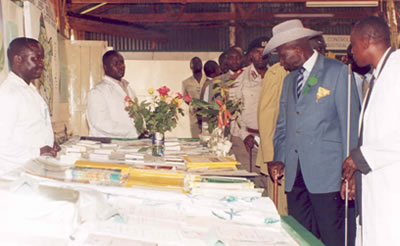
The survey was conducted during the Province's agricultural show,
which was officially opened by Kenya's vice president Honorable Moody
Awori.
Whereas majority of the respondents said they had heard or read
about biotechnology, only one percent said they knew much about it.
Over half of the respondents stated they had little knowledge about
the technology. The survey targeted mainly agricultural extension
workers, teachers, students, policy makers and farmers. Results showed
that most teachers and students in the province were ignorant of
the technology. This means that deliberate outreach programs should
be designed for teachers and students in the province.
Most respondents expressed strong interest in getting more information
aimed at demystifying the technology and make it easily understandable
to the common people while farmers specifically wanted information
about where they could get the improved seeds. Over 1,000 people,
including the Vice President, visited the K-BIC/ABSF stand, with
167 making specific inquiries about biotech products and services.
For more of KBIC visit http://www.isaaa-africenter.org.
 |
| Photo
Caption: Kenya's Vice President Hon. Moody Awori (in hat) looks
at ISAAA publications at the KBIC/ABSF exhibition. |
GM FOOD MAY BE ACCEPTABLE IN EU MARKETS “Our analysis of contingent valuation (CV) data predicts that
food products made of genetically modified (GM) ingredients have
a place in supermarkets in the United Kingdom. The recent decision
of the European Parliament to adopt mandatory labeling and traceability
to ultimately replace the moratorium on approval of new GM crops
represents a significant change in the regulatory environment. The
critical question is whether European food manufacturers and retailers
take the policy change as a positive signal that GM foods are acceptable
and offer GM foods to European consumers,” says Wanki Moon,
assistant professor, Department of Agribusiness Economics, Southern
Illinois University Carbondale; and Siva K. Balasubramanian, Henry
J. Rehn Professor, Department of Marketing, also from the same university.
In their study, Moon and Balasubramanian provided a descriptive
analysis of CV survey data to examine whether there is market for
genetically modified (GM) foods in the European Union (EU). The surveys
were administered to almost 9,000 UK consumers. The highlights of
the research are as follows:
- There
is a non-negligible percentage (ranges from 16% to 38% depending
on the type of question asked) of the UK population who are willing
to buy GM foods if they become available in supermarkets.
- Almost
13 percent (13.3%) of the respondents could be characterized
as GM technology embracing (segment of consumers who support GM technology
and are willing to consume GM foods at no discounts), while 13.8%
can be classified as price-conscious consumers (those who would buy
GM foods only if non-GM foods are more expensive).
- The
percentage of consumers who will purchase GM foods due to their
lower prices will hinge on the price differential between non-GM
and GM foods, or the magnitude of the premiums that non-GM foods
may command.
The research article entitled “Is there a market for genetically
modified foods in Europe? Contingent valuation of GM and non-GM breakfast
cereals in the United Kingdom,” can be found at http://www.agbioforum.org/v6n3/v6n3a06-moon.htm.
FAO RESPONDS TO CRITICISMS ABOUT BIOTECH PERSPECTIVE
The Food and Agriculture Organization's (FAO) State of Food and
Agriculture report reflects the views of known specialists of Member
States on the subject. As regards biotechnology, FAO's position is
determined by its competent statutory bodies under the guidance of
the FAO Conference and of Summits of Heads of State and Government.
This was stressed by FAO Director-General Jacques Diouf in response
to criticisms on the report by nongovernment organizations.
Diouf enumerated the following points as determining FAO's stand
on biotechnology:
- The
FAO/WHO Codex Alimentarius has agreed on the principles and guidelines
for assessing health risks related to foods derived from
modern biotechnology.
- The
FAO/WHO Codex Alimentarius Ad Hoc Intergovernmental Task Force
on Foods Derived from Biotechnology, open to all Member Nations is
the body responsible at international level to elaborate standards,
guidelines or other principles, as appropriate, for foods derived
from biotechnology;
- FAO
has recently published the guidelines adopted by the 130 Members
of the International Plant Protection Convention for pest-risk analysis
for living modified organisms. Such agreements can help harmonize
regulatory procedures globally.
In addition, Diouf said that “we will have
to use the scientific tools of molecular biology, in particular
the identification of molecular
markers, genetic mapping and gene transfer for more effective plant
enhancement, going beyond the phenotype-based methods. Decisions
on the rules and utilization of these techniques must however be
taken at the international level by competent bodies such as the
Codex Alimentarius.”
For the full response, visit http://www.fao.org/newsroom/en/news/2004/46429/index.html.
GM PLANTS TO MANUFACTURE ESSENTIAL FATTY ACIDS
Researchers led by Baoxiu Qi of the University of Bristol, United
Kingdom, reported the production of two very long chain polyunsaturated
fatty acids in substantial quantities in a higher plant. The production
of essential oils in Arabidopsis thaliana suggests transgenic plants
could become a dietary source of these essential fatty acids normally
obtained only from fish.
In an article in the journal Nature entitled “Production of
very long chain polyunsaturated omega-3 and omega-6 fatty acids in
plants”, the researchers discussed the successful genetic engineering
of Arabidopsis to produce arachidonic acid and eiconsapentaenoic
acid.
In the same issue of Nature, Allan Green puts the study in context.
He noted that while the main source for the essential fatty acids
is fish oils, the depletion of fish resources and the accumulation
of toxins in various species becomes a problem. Hence, the research
has enormous potential in developing an alternative source. He cautioned
however, that there continues to be many scientific challenges but
results provide a significant impetus for further research to resolve
these issues.
See the full articles online at http://www.nature.com/cgi-taf/DynaPage.taf?file=/nbt/
journal/v22/n6/abs/nbt972.html and http://www.nature.com/cgi-taf/DynaPage.taf?file=/nbt
/journal/v22/n6/full/nbt0604-680.html.
NEW GM ORCHIDS FROM MALAYSIA
The Malaysian Agricultural Research and Development Institute (MARDI)
is currently bio-engineering orchids to produce varieties with unique
colors such as deep red and dark blue. According to the New Strait
Times (Malaysia), as cited by the Pew Initiative on Food and Biotechnology,
this research is currently being undertaken by the research center
to meet the growing demand for orchids. In Malaysia, orchid exports
presently bring in about RM150 million a year.
To create such varieties, scientists transfer genetic material or
genes into single orchid cells. This technology allows them to develop
hybrids with novel characteristics such as vivid colors, which are
impossible to create using conventional methods such as pollination.
Mardi is also doing research on extending the flowers' shelf life
and improving their shape and structure and resistance to diseases.
Says Dr Umi Kalsom Abu Bakar, deputy director of
MARDI's biotechnology center, "once these (flowers) have bloomed,
we will be able to analyze them to know how colors are formed in
orchids and where
we need to genetically enhance them to get the desired colors. This
will add value to the orchids. Farmers can generate more income while
consumers will have more variety and better quality hybrids.”
The news story is found at http://pewagbiotech.org/newsroom/summaries/display.php3?
NewsID=687.
More news from the New Strait Times (Malaysia) at http://www.nst.com.my/. |


