FAO
REPORT RECOMMENDS POST-RELEASE MONITORING PROCEDURES
The Food and Agriculture Organization (FAO)
has released a report on “Genetically Modified Organisms
in Crop Production and Their Effects on the Environment:
Methodologies for Monitoring and the Way Ahead,” the
documented results of a recently-conducted consultation
with experts in the field of agricultural biotechnology.
The consultation aimed to review the scientific basis for,
and procedures to establish, effective post-release monitoring
of genetically modified (GM) crops, and develop guidelines
to strengthen member countries’ capacities to design
and carry out monitoring programs.
According to the report, the key steps for
developing a robust monitoring program for the release
of GM crops entails member countries setting their program
goals and immediate objectives; identifying potential barriers,
as well as risks and benefits, through the use of stakeholder
and expert knowledge; developing a testing hypothesis to
guide actions and decisions; identifying a limited number
of potential indicators; determining appropriate trigger
values for decision making and action; and cultivating
a transparent and effective process of monitoring.
Download the complete report at ftp://ftp.fao.org/docrep/
fao/008/ae738e/ae738e00.pdf or visit http://www.fao.org/ag/
COMPLIANCE
MANAGEMENT DOCUMENT FOR GM FIELD TRIALS
CropLife
International, a federation representing the plant science
industry, has released “Compliance Management of
Confined Field Trials of Genetically Engineered Plants,” a
generic compliance management document that serves as a
guide for those undertaking field trials of genetically
modified crops.
The
federation recognizes the value of information that may
be gained from confined field trials, and the document
sets forward guidelines in order for field trials to be
carried out successfully. Among other goals, it seeks to
help ensure uniform compliance with the terms and conditions
of authorization for confined field trials; address a gap
in many countries where there are no clear educational
tools for regulators; and serve to help countries with
no national biosafety framework in place by a) demonstrating
confidence that industry is committed to ensuring that
trials are undertaken under appropriately controlled conditions
and b) providing a model around which biosafety guidelines
can be developed.
The
document can be accessed at http://www.croplife.org/
library/documents/Biotech%20issues/stewardship/
2005%2005%2010-field%20trial%20compliance%20
protoco-psl-f.td.pdf.
ADOPT
AGRI-BIOTECH, ECOWAS URGED
Members
of the Economic Community for West African States (ECOWAS)
have been urged to adopt agricultural biotechnology to
help increase productivity and fight hunger and poverty
in the sub-region. This was according to the Malian Minister
for Agriculture, Honourable Seydou Traore, who opened this
year’s Ministerial Conference of ECOWAS countries
on biotechnology in Bamako, Mali.
“We
hope this Conference will allow measures to be taken that
will hasten the adoption of a technique that can render
our agriculture non-dependent on climate hazards while
improving its technical and economic performances,” the
Minister said. The conference has brought together Ministers
from various West African States, international and regional
organizations, farmers, consumer groups, industry, and
the media.
The
Executive Secretary of the Forum for Agricultural Research
in Africa (FARA), Dr Monty Jones, who led research leading
to the development of New Rice for Africa (NERICA), made
an appeal for African countries to create enabling environments
for the adoption and utilization of modern agricultural
biotechnology into the continent’s agricultural systems.
Madelyn
E. Spirnak, senior advisor for agricultural biotechnology
US Department of Agriculture pledged her government’s
support for the regional initiate and expressed hope that
the ministerial meeting “will help ECOWAS countries
develop a coordinated strategy to address the need to develop
a practical framework for modern biotechnology, capacity
building in regulatory and research fields, and increase
public awareness.”
News
provided by Daniel Otunge (dotunge@absfafrica.org)
of the Kenya Biotechnology Centre and the African Biotechnology
Stakeholders Forum.
WHO REPORT
CALLS FOR GLOBAL COOP ON BIOTECH ASSESSMENT
The
World Health Organization exhorts its member countries
to cooperate on the assessment of biotechnology and its
impact human health and food production. This need for
international collaboration is the gist of its latest report, “Modern
Food Biotechnology, Human Health, and Development.”
The
report documents evidence and work related to the risks
and benefits of biotechnology on human health and the environment,
socio-economic factors related to the adoption of biotechnology,
and ethical aspects pertaining to its use. It aims to create
a knowledge base for the application of biotechnology in
agriculture and food production, as well as to initiate
international discussions on the matter.
For
effective discussions and decision-making, the report recommends
that stakeholders and policy makers should analyze and
weigh the costs and benefits, such that even the intended
scope of beneficiaries of the technology should be defined;
find new ways of improving communication between scientists
in the development of products; and take into consideration
ethics and socio-economic aspects of agricultural biotechnology,
among others.
Download
the complete report at
http://www.who.int/foodsafety/biotech/who_study/
en/index.html
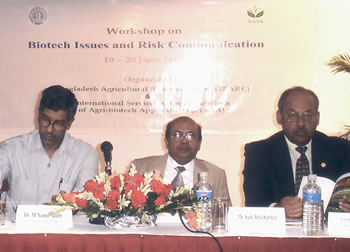
BANGLADESH
SUPPORTS BIOTECH INITIATIVES
Biotechnology
is a viable option that Bangladesh should consider to improve
its agricultural productivity given the country’s
growing population and the limitations of conventional
breeding research. This was declared by Hon. Kazi Abul
Kashem, Secretary of the Ministry of Agriculture of Bangladesh,
during the Biotechnology Issues and Risk Communication
Workshop in Dhaka last June 19-20, 2005. Similar views
were forwarded by Dr. Nurul Alam, Chair of the Bangladesh
Agricultural Research Council (BARC), and Dr. Md Abdur
Razzaque, Member-Director for Crops of BARC, who graced
the opening ceremonies of the said workshop.
Dr.
Razzaque added that there is an urgent need for productivity
enhancement of agricultural crops and animals as well as
nutritional quality citing the country’s problems
with food and livelihood security. He noted that “biotechnology
can be instrumental in the conservation, characterization,
and valuation of biodiversity, and that high priority should
be assigned to this.” He particularly forwarded strategies
and actions to harness biotechnology, among them speeding
up the national policy on biotechnology, streamlining the
regulatory mechanisms in support of biotech initiatives,
strengthening institutional capability, and encouraging
awareness raising and information empowerment.
The
two-day workshop, which was attended by over 50 scientists
and academic staff of various universities, and research
and development agencies, was organized by the Bangladesh
Agricultural Research Council and the International Service
for the Acquisition of Agri-biotech Applications. Additional
information on the workshop may be obtained by emailing
Dr. Khondoker Nasiruddin of ISAAA’s Bangladesh Office
at k.nasiruddin@isaaa.org.
PHILIPPINES
DECLARES NATIONAL BIOTECH WEEK
President
Gloria Macapagal-Arroyo of the Philippines recently signed
Presidential Proclamation No. 861 declaring the first week
of July 2005 as “National Biotech Week.” Arroyo
designated the Department Secretaries of Agriculture, Science
and Technology, Environment and Natural Resources, Trade
and Industry, and the Interior and Local Government to
compose a National Biotechnology Week Committee.
The
Committee, which is co-chaired by the Secretaries of Agriculture,
and Science and Technology, was tasked to formulate a program
for a meaningful celebration of the National Biotechnology
Week. A week-long celebration with the theme “Biotechnology
for Life” will be held from July 1-7, 2005 in Manila
with several activities that include the launching of the
Biotechnology Intellectual Property Center, farmer-to-farmer
exchange on biotechnology, and a scientific symposium and
exhibit on biotechnology.
For
more details on National Biotechnology Week in the Philippines,
contact Dr. Benigno Peczon, President and CEO of the Biotechnology
Coalition of the Philippines at bdpeczon@bcp.org.ph or bpeczon@yahoo.com.
DEVELOPING
COUNTRY DBASE UPDATED
The
Food and Agriculture Organization’s (FAO) database
containing “Developing Country Biotechnology Profiles” has
been updated. The database, FAO-BioDeC, is a searchable
tool that aims to provide easy access to key, updated sources
of biotechnology-related information, contained in entries
from 128 developing countries (including countries with
economies in transition).
Information
on each country may be classified and stored into any of
11 key subjects, which include biotechnology research policy,
research capacity, regulatory frameworks, biotechnology
applications, and publications and links. The database
will be expanded in a second phase to include the animal,
fisheries, and forestry biotechnology sectors.
Access
the database at http://www.fao.org/biotech/
inventory_admin/dep/default.asp or contact FAO-BioDeC@fao.org to
provide comments or to request more information.
CIAT
LAUNCHES SPANISH EDUC MATERIALS
Professionals
from the Centro Internacional de Agricultura Tropical (CIAT)
have been working with a group of schoolteachers in Cali,
Colombia to produce Spanish-language educational materials
related to biotechnology. The collaboration’s efforts
have resulted in a recently launched CD-ROM entitled “La
Biotecnología en el salón de clases,” or
Biotechnology Goes to School.
The
CD aims to create a space where students can learn about
biotechnology and become familiar with several of its techniques.
It contains different theoretical documents meant for teachers,
as well as practical exercises related to biotechnology,
for students to “learn by doing.”
The
CD is produced by experts from CIAT’s Agrobiodiversity
and Biotechnology Project, in cooperation with the Auxiliary
Center of Teaching Services (CASD) of Colombia. See http://www.ciat.cgiar.org/biotechnology/launching_cd.htm or
contact c.s.zuniga@cgiar.org for
more information.
OECD REPORTS
ON INDIA BIOTECH
“It
is important that India comes out with a comprehensive
national policy to balance national socio-economic priorities
with adequate technological expertise.” This is the
main thrust of the latest addition to the STI Working Paper
series, from Organization for Economic Co-operation and
Development (OECD) Directorate for Science, Technology,
and Industry.
“Dynamics
of biotechnology research and industry in India: Statistics,
perspectives and key policy issues” is written by
S. Chaturvedi, and provides information on India’s
growing biotechnology industry. Among others, it contains
an inventory of biotechnology data collection in India,
and an overview of the status of biotechnology in India,
with a focus on the agricultural and health sectors.
The
paper also proposes steps which may help the industry grow.
It recommends that the country prioritize public sector
research; coordinate between agencies; stress on innovation
and the work of star scientists through identifying core
areas of competencies; work on an innovation system for
small and medium scale enterprises; develop a statistical
framework; and join and integrate into regional forums,
like the Asian Cooperation dialogue (ACD).
See http://www.oecd.org/dataoecd/43/35/34947073.pdf or
contact dsti.contact@oecd.org for
more information.
SARS
VACCINE BEING DEVELOPED IN PLANTS
With
Severe Acute Respiratory Syndrome (SARS) threatening to
be a worldwide epidemic, scientists are constantly trying
to find new ways to both cure people of and protect them
from the disease. The causative agent is a coronavirus,
and one of its proteins (referred to as the S protein)
and its truncated fragments are considered the best candidates
for generation of a recombinant vaccine.
In “Severe
acute respiratory syndrome (SARS) S protein production
in plants: Development of recombinant vaccine,” Natalia
Pogrebnyak and colleagues of the Biotechnology Foundation
Laboratories, Thomas Jefferson University in Philadelphia,
USA carry out preliminary work on producing a SARS vaccine
in plants, as well as testing it on model organisms. Their
work appears in the latest issue of the Proceedings of
the National Academy of Sciences.
The
researchers used tomato and tobacco plants, since tomato
is easy to transform and can produce a good number of edible
fruit tissue; while tobacco is an efficient transformation
system to test the expression and activity of new proteins.
They expressed a fragment of the SARS S protein in the
plants, selected those with the highest levels of protein
expression, and fed the transformed plant materials to
mice. Mouse sera and fecal pellets were then assayed for
the presence of antibodies specific for SARS.
Researchers
found that the mice showed increased levels of a specific
antibody after being orally fed with tomato expressing
the S protein. Three immunizations with transgenic tobacco
material, however, did not increase the antibody level
in the mice, but a booster shot of the peptide itself prompted
a secondary immune response.
Download
the article at http://www.pnas.org/
cgi/reprint/102/25/9062
|
| CBTNews
Features |
THE
WORLD FISH CENTER
The
World Fish Center is an international scientific research
organization that aims to reduce poverty and hunger
by improving fisheries and aquaculture, especially
for developing countries. It is a member of the Consultative
Group on International Agricultural Research (CGIAR). |
| Read
more... |
| |
IFPRI
RELEASES BOOK ON BIOTECH IN SOUTHERN AFRICA
The
International Food Policy Research Institute (IFPRI) and
the Food, Agriculture, and Natural Resources Policy Analysis
Network (FANRPAN) have released “Biotechnology, Agriculture,
and Food Security in Southern Africa,” which tackles
the biotechnology debate in the continent.
The
debate has since prompted both organizations to raise awareness,
promote dialogue, and catalyze consensus-building mechanisms
to improve the institutions and policies governing agricultural
biotechnology, as well as to assess its implications for
food security in southern Africa. The book is a result
of the initiative, and brings together experts from within
and outside Africa to discuss various aspects of the biotech
issue.
Read
more at http://www.ifpri.org/
pubs/books/oc46.htm.
FAO
BIBLIOGRAPHY ON AGRI-BIOTECH AVAILABLE
The
Food and Agriculture Organization’s (FAO) Research
and Technology Development Service has published a bibliography
of documents that cover assessments of the economic and
socio-economic impact of agricultural biotechnology in
developing countries, with a focus on crop biotechnology.
“Economic
and Socio-Economic Impacts of Agricultural Biotechnology
In
Developing Countries” contains bibliographic information on publications
covering methodologies for impact assessment; studies on biotechnologies not
involving genetic modification (GM), such as marker assisted selection and
micropropagation; and GM-based biotechnologies, with specific crop studies
on cotton, soybean, rice, maize, and banana, among others.
Download
the document at ftp://ftp.fao.org/sd/SDR/
SDRR/bibliography1.pdf, or contact SDRR-portal@fao.org for
more information or to provide comments.
COP-MOP
REPORT RELEASED
The
2nd meeting of the Conference of the Parties, serving as
the meeting of Parties to the Cartagena Protocol on Biosafety
(COP-MOP/2), took place from May 30 to June 3 of this year
in Montreal, Canada, on the premises of the International
Civil Aviation Organization. The proceedings of the meeting
are now available online, and may be downloaded at http://www.biodiv.org/
doc/meetings/bs/mop-02/
official/mop-02-15-en.pdf. Contact secretariat@biodiv.org for
further information.
DATABASE
ON PLANT BIOTECH PROJECTS
The
Plant Biotech Projects database, a comprehensive world-wide
information resource covering plant biotechnology research
and development, is now available in print, CD ROM, and
electronic formats. Four modules are available: plants
as factories, input traits, crop production, and quality
traits. Contact Michael Aplin at michael.aplin@informa.com
for order requests or visit http://www.plantbiotech
projects.com. |