EU
COURT: AUSTRIA CAN'T BAN GM PLANTING
The
European Union (EU) Court of First Instance dampened
the draft law set by the Upper Austria Region to ban
the planting of genetically modified crops. The Court
said Austria failed to present science-based data to
justify their case and arguments invoking the precautionary
principle lacked merit.
Simon
Barber, Director of the Plant Biotechnology Unit at EuropaBio,
EU's association for bioindustries, said that the “ruling
confirms that Member States may not abuse safeguard procedures
to prohibit the use of safe, licensed GM products in
their territory.”
Austria
notified the Commission in March 2003 of the Oberösterreichisches
Gentechnik-Verbotsgesetz 2002, a draft law of the Land
Oberösterreich (Province of Upper Austria) banning
genetic engineering. The measure prohibited the cultivation
of GM seed and planting material and secured a derogation
from EU rules.
The
EuropaBio website at http://www.europabio.org provides
a link to the court order.
Meanwhile,
Friends of the Earth (FOE) Europe has issued a statement
calling for a new EU law that would allow individual
European regions to ban all genetically modified (GM)
crops within their territories. Their press release can
be viewed online at http://www.foeeurope.org/GMOs/publications/
EFSAreport.pdf
VIETNAM CONFERENCE SETS SOLUTIONS TO BOOST BIOTECH
Proposals
to boost biotechnology in Vietnam were forwarded during
a conference organized by the Vietnamese Party's Commission
of Science and Education and the Ministry of Science
and Technology. These include: building of research and
training centers of international standards, establishing
venture investment funds for production, and setting
up suitable mechanism and policies for the development
of biotechnology.
Minister
of Science and Technology Hoang Van Phong requested relevant
ministries and local units to assure implementation of
the Government's action plan on biotechnology.
The
action plan specifies that the country will focus on
developing and applying bio-technology in agriculture,
aquaculture, medicine, processing, and environmental
protection.
In
the same conference, Tran Duy Quy, Director of the Vietnam
Agricultural Genetics Institute, noted that biotechnology
products developed by Vietnamese research institutes
generate some 50 billion Vietnam Dong (US $3M) annually.
These products include agbiotech products, enzyme proteins,
and biofertilizers.
More
news summaries from Vietnam are available from Le Hien
of Biotech Vietnam at hienbiotechvn@pmail.vnn.vn.
INTERNATIONAL EXPERTS DISCUSS FOOD SAFETY IN AFRICA
Experts
from 50 countries have converged in Harare, Zimbabwe
to discuss ways to ensure safer food for better health
and agricultural trade opportunities in Africa. They
note that an improvement in the food safety system could
reduce about 2000 deaths daily as a result of food and
water contamination.
Organized
by the Food and Agriculture Organization and the World
Health Organization, the Regional Food Safety Conference
will discuss an Africa-wide Strategic Plan of Action
for Food Safety to reduce future threats to public health
and international trade caused by contaminated food and
food products that do not meet international quality
and safety standards. An example is the control of mycotoxins
in staple African crops such as maize, groundnuts, and
dried fruits.
Contact
John Riddle of FAO for more information at John.Riddle@fao.org or
see the FAO release at http://www.fao.org/newsroom/en/news/2005/107908/
index.html
BRAZIL BIOSAFETY CONGRESS YIELDS MANIFESTO
The
4th Brazilian Congress on Biosafety , and the 4th Latin-American
Symposium on Transgenic Products were held last September
26-29 in Porto Alegre , Brazil. The events were presided
over by 95 lecturers, and attended by 720 participants
from 20 different countries, along with representatives
from the Food and Agriculture Organization (FAO), the
World Health Organization (WHO), the United Nations Environment
Program (UNEP), and the United Nations Educational, Scientific,
and Cultural Organization (UNESCO).
Organized
by ANBio, the National Biosecurity Association, the meeting
aimed to strengthen the cooperation amongst Latin American
countries in terms of biosecurity, biosafety regulations,
and public communication and perception. Talks were delivered
explaining the approaches of different countries regarding
the issues, as well as similarities in the ways by which
the same countries developed their laws, regulations,
and communication strategies. The meeting also featured
a regional workshop that aimed to work on a Technical
Platform for Regional Cooperation on Biosafety.
The
program covered the different aspects of biosecurity,
from biosafety in human health, to biosafety in the use
of genetically modified organisms. Speakers included
Dr. Mirian Gallardo of the National Institute of Agricultural
Research in Argentina, who presented the results of nine
years of feeding studies on animals who were fed with
feed products derived from genetically modified (GM)
organisms. Her research showed that GM feed is as safe
as its conventional counterparts.
Dr.
Graham Brookes of the United Kingdom also presented his
nine-year study of the environmental and economic benefits
received by countries which have been planting Bt cotton,
Bt corn, and RR soybean. Other speakers included Dr.
Klaus Amman, and Dr. Peter Bennett.
Congress
participants also signed and approved a Manifesto, recommending
urgent regulation of the Biosafety Law approved last
March, as well as development of GM research in the country.
The Manifesto was sent to Brazil's President Lula.
See the Manifesto and news from the meeting in ANBio's web site: http://www.anbio.org.br.
FIRST BIOTECH INSTITUTE IN ETHIOPIA
The
first biotechnology institute in Ethiopia, Africa is
currently being constructed. Made possible through a
World Bank loan, the research complex will do research
on both crops and animals. Aside from research laboratories,
the institute will also house offices, staff living quarters,
and guest houses.
Yohannes
Gojjam, Manager of the Holeta Agricultural Research Center,
said that the research complex will be operational next
year. Meanwhile, senior research personnel have completed
intensive training and foreign experts are expected to
provide assistance when the buildings are ready for use.
Additional
details may be obtained by emailing Dr. Tilahun Zeweldu,
regional coordinator of the Agricultural Biotechnology
Support Project II East and Central Africa Advisor, Uganda
at either tila@apepuganda.org or zeweldu@msu.edu.
COTTTECH TO RAISE LEVEL OF COTTON RESEARCH IN AUSTRALIA
CottTech,
a joint venture of cotton research groups in Australia,
including the Commonwealth Scientific and Industrial
Research Organization (CSIRO), and the Cotton Research
Corporation, is set to implement innovative research
approaches to improve the cotton industry in the country.
CSIRO
Plant Industry Chief Jeremy Burdon said that existing
cotton research provides regular but step-by-step gains
to cotton growers. “CottTech will concentrate on
the fundamental science and allow researchers to be more
creative and original in their research.” Research
will focus on removing “constraints on production
and ultimately deliver beneficial traits faster through
improved breeding techniques.”
See
CSIRO's release on CottTech at http://www.csiro.au/index.asp?type=media
Release&id=187cottTech&style=mediaRelease
ORIGIN OF POTATO IS PERU, SAYS TAXONOMIST
A
single origin in southern Peru is the original home of
the cultivated potato. So says a team led by David Spooner
of the United States Department of Agriculture. The team
wrote in the Proceedings of the National Academies of
Sciences that they had analyzed DNA markers in 261 wild
and 98 cultivated potato varieties to assess whether
the domestic potato arose from a single wild progenitor
or whether it arose multiple times.
Spooner
said that "The multiple-origins theory was based
in part on the broad distribution of potatoes from north
to south across many different habitats, through morphological
resemblance of different wild species to cultivated species,
and through other data. Our DNA data, however, shows
that in fact all cultivated potatoes can be traced back
to a single origin in southern Peru."
Email
David Spooner at dspooner@wisc.edu for
additional information.
FIRST
NINE YEARS OF GM ASSESSED
Graham
Brookes and Peter Barfoot of PG Economics Ltd., UK take
stock of how biotech crops have made an impact in the
first decade of their use. Their article, “GM Crops:
The Global Economic and Environmental Impact - The First
Nine Years 1996-2004,” appears in the online Agbioforum
journal.
Both
researchers found that the use of biotech crops in the
last nine years has brought substantial net economic
benefits at the farm level amounting to a cumulative
total of $27 billion. They pointed out gains in important
crop sectors such as cotton, which has benefited from
an additional $6.5 billion in terms of farm income levels
since 1996.
They
also found that the use of biotech crops has reduced
pesticide spraying by 172 million kg, as well as the
environmental footprint associated with pesticide use
by 14%. In the maize sector, pesticide use decreased
by 24 million kg; while farmers reduced herbicide use
by 5 million kg in the canola sector.
Researchers
also found that the technology has significantly reduced
the release of greenhouse gas emissions from agriculture,
which is equivalent to removing five million cars from
the roads.
Read
the complete article at http://www.agbioforum.missouri.edu/
v8n23/v8n23a15-brookes.htm.
COMPUTER SIMULATION PREVIEWS MAS COST
Marker
assisted breeding (MAS) makes use of molecular markers
to ensure that a specific gene is incorporated into a
specific locus in a plant cell. This high precision technique,
however, is perceived to be costly compared with traditional
breeding methods.
In "Genetic
and economic analysis of a targeted marker-assisted wheat
breeding strategy," Haydn Kuchel, of Australian
Grain Technologies, and colleagues use computer simulation
to design a genetically effective and economically efficient
marker-assisted breeding strategy aimed at producing
rust resistant wheat. Their findings are published in
Molecular Breeding.
Researchers
used the QU-GENE simulation software to examine how best
to maximize MAS at lowest cost. The results of their
simulation showed that the economic success of MAS will
vary with the stage at which the markers are deployed
and the number and value of genes selected. MAS, in fact,
could provide not only genetic gain but reduced overall
cost by as much as 40%. Read
more about the research findings by downloading the complete
article at http://dx.doi.org/10.1007/s11032-005-4785-7.
If you are not a Molecular Breeding subscriber, you may
still view the abstract at the same site.
SUBSTANTIAL EQUIVALENCE BETWEEN GM, CONVENTIONAL POTATOES STUDIED
The
concept of substantial
equivalence is important when
studying the safety of biotech crops. This involves comparing
the biotech crop with its conventional counterpart. If
both are nearly the same in terms of nutritional content,
water content, metabolite composition, etc., then they
are deemed substantially equivalent, or satisfactorily
one and the same.
Gareth
S. Catchpole of the Max Planck Institute for Molecular
Plant Physiology, and colleagues explore the concept
in greater detail in “Hierarchical metabolomics
demonstrates substantial compositional similarity between
genetically modified and conventional potato crops.” Their
work appears in the latest online issue of Proceedings
of the National Academy of Sciences.
By
fingerprinting the total metabolites of field-grown biotech
and conventional potato tubers, and comparing the data,
researchers found that apart from the changes expected
in the genetically modified potatoes, all the potatoes
in the study were substantially equivalent to each other.
They also found large variations in the metabolite profiles
of conventional cultivars - but the metabolite profiles
of the biotech potatoes were well within the natural
metabolite range of the conventional lines, and were
similar to the Désirée progenitor line
as well.
Read
the complete article at http://www.pnas.org/cgi/
content/full/102/40/14458.
BARLEY GIVES SALT TOLERANCE TO GM OAT
Oat is a major cereal crop important to human and animal
diets. A successful oat harvest is highly dependent on
osmotic stress, which in turn may be affected by drought
or soil salinity. Most oat cultivars are moderately tolerant
to such stresses, but soil salinity can decrease oat
seed germination and stunt subsequent development in
some cultivars.
Due
to the complexity of the salt tolerance trait, traditional
breeding has hitherto been unsuccessful in oat improvement.
Hesham F. Oraby, of Michigan State University, and colleagues
take the first step in genetic enhancement of the crop
as they find that “Barley HVA1 Gene Confers Salt
Tolerance in R3 Transgenic Oat.” Their work is
published in the Crop Science journal.
Researchers
introduced three genes into oat: HVA1, from barley, for
stress tolerance; B-glucoronidase; and the bar herbicide
resistance gene. An analysis of the transgenic plants
showed that the genes had been stably transferred and
expressed. The plants also showed increased tolerance
to salt stress conditions, as well as better growth during
the recovery period. Researchers also found that higher
salinity levels significantly reduced plant growth of
both transgenic and control plants
Subscribers
to Crop Science can download the article at http://crop.scijournals.org/cgi/content/full/45/6/2218.
Other readers can take a look at the abstract at http://crop.scijournals.org/cgi/content/abstract/45/6/2218.
| UPDATES
FROM THE BIOTECHNOLOGY INFORMATION CENTERS |
BIOTECH
SEMINAR IN MAKASSAR
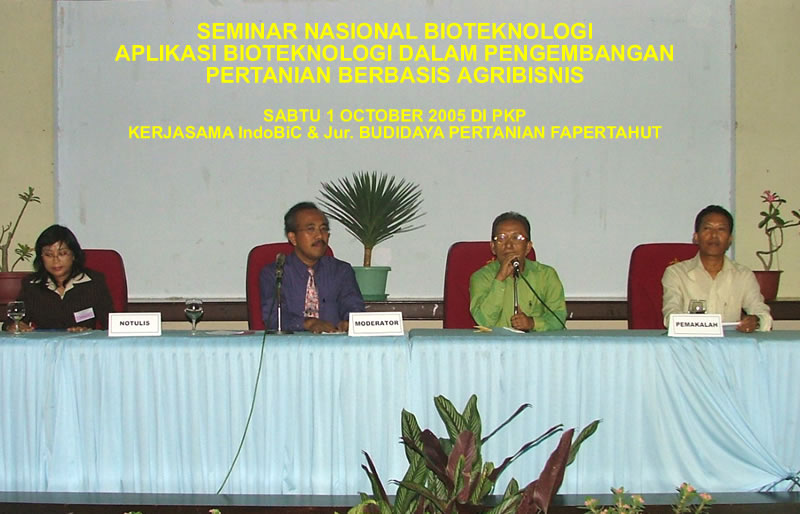
A
challenge for the world is to feed an increasing population,
forecasted to reach 11 billion by 2050, out of whom 90
% will be in developing countries including Indonesia.
Thus, a method that can complement conventional breeding
and produce agricultural products more efficiently and
competitively in the global market to feed a burgeoning
population is highly desired. To facilitate the discussion
on that topic, the Indonesia Biotechnology Information
Center (IndoBIC) based in Bogor collaborated with the
agriculture and forestry department of Hasanuddin University,
Makassar to conduct a seminar on “Application of
Biotechnology for Sustainable Agriculture Development
Based on Agribusiness”. The seminar was attended
by 130 participants coming from different research and
academic institutions in Sulawesi.
Indonesian
experts gave talks on quality improvement of plant genetics
through biotechnology application; development of transgenic
plans; role of biotechnology to support environment-based
agriculture; and activities of IndoBiC.
Details
of the seminar may be obtained from Bambang Purwantara
of IndoBic at b.purwantara@biotrop.org.
DHAKA EDITORS URGED TO FORM BIOTECH JOURNALISTS FORUM
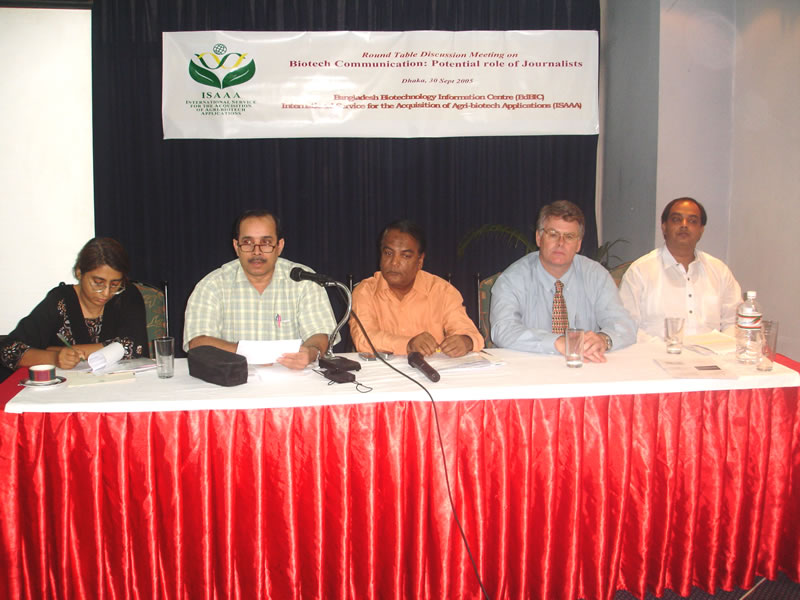
Kazi
Shiraz, editor of the Bangladesh newspaper Dinkal called
for the formation of a Biotech Journalists Forum during
a roundtable discussion on "Biotech Communication:
Potential Role of Journalists" in Dhaka, Bangladesh.
Around 50 journalists joined the discussions, which were
presided by the editors of the New Nation, the Dinkal,
and the Khaborpatro.
Organized
by the Bangladesh Biotechnology Information Centre (BdBIC),
the roundtable discussion enabled local scientists, led
by Dr. Lutful Hassan of Bangladesh Agriculture University,
to share information with journalists on the importance
and prospects of biotech in Bangladesh, and the global
status of commercial biotechnology. Dr. Donald MacKenzie,
executive vice president of AgBios Canada, discussed
food, health, and food safety of biotech crops. In return,
newspaper editors talked about the potential role of
journalists in science and biotech communication, as
well as on the contribution of mass media for awareness
building and public perception of biotech.
Email
BdBIC head Kondoker Nasiruddin (nasirbiotech@yahoo.com)
for additional information on the media forum.
BOOK
ON WHITEFLIES
Whiteflies
and their viruses are two of the worst crop pests that
impact on agricultural sustainability, environment and
human health. “Whitefly and Whitefly-borne Viruses
in the Tropics: Building Knowledge Base for Global Action”,
is a collection of three decades of research on the topic
by an international team of experts. The book is available
online at http://www.tropicalwhiteflyipmproject.cgiar.org/book-wf.jsp.
INTERNATIONAL RICE GENETICS SYMPOSIUM
The
EDSA Shangri-la Manila, Philippines is the site of the
5th International Rice Genetics Symposium on November 19-23,
2005. The Symposium, held every 5 years, explores developments
in rice genetics and their applications. The 3rd International
Symposium on Rice Functional Genomics will also be held
under the auspices of the International Rice Functional
Genomics Consortium. More details of the symposium are
available at http://www.irri.org/rg5.
CONFERENCE ON THE FUTURE OF FOOD
Join
a discourse on the future of the food industry such as
health and wellness, market access, regulation, emerging
science and innovation, during the GMA Conference on the
Future of Food on November 29-December 1, 2005. This will
be held at the Ronald Reagan Building, International Trade
Center, Washington, D.C.
Those
interested to register online may visit https://www.seeuthere.com/rsvp/invitation/
invitation.asp?id=/m2c79e-416061647196
NOMINATIONS OPEN FOR INTERNATIONAL RICE PRIZE
Nominations
are now being accepted for the 2006 Koshihikari International
Rice Prize award. Two institutional rice researchers will
be given a cash prize of 500,000 Japanese yen in a ceremony
in Koshihikari in Fukui-City. For more information, visit
http://www.geocities.jp/koshihikarinet/.
|