GHANA FORMULATES BIOSAFETY FRAMEWORK Christine Churcher, Ghana's Minister of Environment and Science,
recently launched the country’s National Biosafety
Framework in Accra, Ghana. This framework is meant to ensure
an adequate
level of production in the field of safe transfer, handling,
and use of living modified organisms resulting from modern
biotechnology.
“By the accession,” Ms. Churcher said, “We
affirm our position for the safe use, handling, and transportation
of genetically modified organisms that might find [their] way
to Ghana.” She assured Ghanaians that all GMOs will
pass through rigorous inspection to ensure that they conform
to
the country's regulations and standards.
Edward Nsenkyire, Chief Director of the Ministry of Environment
and Science, stressed that Ghana's position on the issue is
strictly based on the precautionary principle, and that every
effort will be made to ensure safety in the use of GMOs. Professor
Alfred Oteng-Yeboah, Chairman of the National Biodiversity
Committee, said that with the national framework in place,
wildlife and other organisms in Ghana would be adequately cared
for and protected.
With reports from http://allafrica.com/stories/
200508180613.html and http://www.ghanaweb.com/
GhanaHomePage/NewsArchive/artikel.php?ID=88180.
For more information on the framework, visit http://www.unep.ch/biosafety/partcountries/
GHcountrypage.htm.
Download the a copy of the document at
http://www.unep.ch/biosafety/development/
countryreports/GHNBFrep.pdf.
CALL FOR BIOTECH DEVELOPMENT IN BANGLADESH
Bangladesh
has to focus on capability building in both public and private
sectors to encourage biotechnology development
in the country. This was stressed by Dr. M.A. Halim Khan, Vice
Chancellor of the BSMR Agricultural University, who served
as chief guest during the workshop on “Reporting biotechnology:
Issues and opportunities for the news media” held at
the BRAC Centre, Dhaka.
Abdul Awal Mintoo of the East-West Seed Co. in Bangladesh
said that his company was committed to spend TK20 crore or
more to develop a modern biotechnology laboratory in Bangladesh.
Biotechnology experts who spoke during the workshop called
for efforts to create greater public awareness on biotechnology
particularly with regards the issue of safety. It was announced
that while biotech crops are not yet commercially planted in
Bangladesh, seeds of Golden Rice have already been brought
into the country for experimentation at the Bangladesh Rice
Research Institute. Biosafety guidelines have been set and
are awaiting approval.
The two-day workshop was organized by the International Service
for the Acquisition of Agri-Biotech Applications (ISAAA) Bangladesh
Office, International Crops Research Institute for the Semi-Arid
Tropics (ICRISAT), and Syngenta Foundation for Sustainable
Agriculture. More information about the workshop can be obtained
from KM Nasiruddin, ISAAA Bangladesh country coordinator, at
k.nasiruddin@isaaa.org.
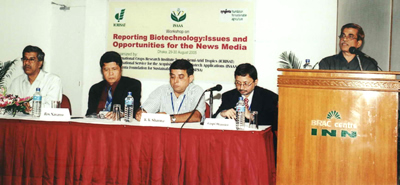 |
| Dr
M A Halim Khan, Vice Chancellor of the BSMR Agricultural
University, calls for greater initiatives in biotechnology. |
EU
OKS BIOTECH RAPESEED AS ANIMAL FEED
The European
Commission has given a 10-year permission to Monsanto Co.
for a herbicide resistant rapeseed to be imported
into 25 nations for animal feed. This is the Commission’s
second approval of a Monsanto-developed product, the first
being a biotech corn product resistant to rootworm also for
animal feed.
Known as GT73, the rapeseed product was pronounced to be safe
as conventional oilseed in a scientific evaluation conducted
earlier. It is currently grown in the United States, Australia
and Canada and is allowed for sale in those countries including
Japan, the Philippines and South Korea.
Additional details may be obtained from
http://quote.bloomberg.com/
apps/news?pid=10000080&sid=a8rflmlRvF1c.
TRANSGENIC ALFALFA PRODUCES ISOFLAVONES
Isoflavonoids are an interesting group of compounds: they
are produced mostly by legumes in response to plant stress,
but have also shown potential in combating hormone-dependent
cancers, cardiovascular disease, osteoporosis, and menopausal
symptoms. Engineering isoflavonoid biosynthesis in plants
can thus provide a good source of these compounds, for plant-based
dietary supplements, and for providing plants extra defense
mechanisms.
Bettina E. Deavours and Richard A. Dixon of the Samuel Roberts
Noble Foundation set out to perform “Metabolic Engineering
of Isoflavonoid Biosynthesis in Alfalfa.” They engineered
alfalfa leaves to produce genistein glucoside without affecting
regular plant growth or the expression of other alfalfa genes.
Their findings appear in the latest issue of the Plant Physiology
journal.
Using the IFS gene from the model legume Medicago truncatula,
or the barrel medic, researchers successfully generated transgenic
alfalfa producing, among other isoflavonoids, genistein.
Since genistein is not normally synthesized in alfalfa leaves,
scientists used microarrays to track if its accumulation
caused any unexpected effects on gene expression. Tests showed,
however, that gene expression carried on as usual.
Plant Physiology subscribers can read more by accessing
the full article at http://www.plantphysiol.org/cgi/
reprint/138/4/2245.
Other readers can view the abstract at http://www.plantphysiol.org/cgi/content/abstract/138/4/2245.
FINDINGS ON MEXICO MAIZE RELEASED
Sometime in 2000, scientists released research findings
that stated that they had found evidence of genetically modified
corn in maize landraces grown in Oaxaca, Mexico. This was
significant, because transgenic maize has never been approved
for cultivation in the country.
Five
years later, S. S. Ortiz-García and colleagues
publish their findings in the Proceedings of the National
Academy of Sciences. Their article, “Absence of detectable
transgenes in local landraces of maize in Oaxaca, Mexico
(2003–2004),” is published in the journal’s
latest electronic edition.
Researchers worked on 70 plants in 125 fields and 18 localities
in the state of Oaxaca during 2003 and 2004. They performed
the polymerase chain reaction (PCR) on DNA samples from 153,746
sampled maize seeds, screening for the 35s promoter of the
cauliflower mosaic virus and the nopaline synthase terminator
from Agrobacterium tumefaciens, with the PCR reaction optimized
to detect at least 0.01% transgenic material. One or both
of the transgene elements are present in all transgenic commercial
varieties of maize.
PCR could not detect any transgenic sequences in the seeds
sampled, and authors conclude that transgenic maize seeds
were absent or extremely rare in the sampled fields. They,
however, caution readers about the limitations of their research.
For instance, their seed sampling may not have been thorough,
and the samples could be less than representative of the
local maize crop. They also caution readers from extrapolating
the findings to other regions of Mexico, or from considering
the current situation likely to remain unchanged.
For
more information, download the article at http://www.pnas.org/cgi/content/full/102/35/12338.
BRASSICA GENE IMPROVES STRESS TOLERANCE IN CHINESE CABBAGE Late embryogenesis abundant (LEA) protein genes are expressed
by plants during the later stages of seed development, but
may also be expressed when plants are exposed to environmental
stresses. This means that engineering LEA genes into plants
could give these plants a chance to survive under environmental
stresses, such as salinity and drought.
In the
September issue of the Journal of Plant Science, Byong-Jin
Park of Tohoku University, Japan and colleagues
report the successful “Genetic improvement of Chinese
cabbage for salt and drought tolerance by constitutive expression
of a B. napus LEA gene.” Chinese cabbage is an important
vegetable in Asia, especially in China, Korea, and Japan.
Using Agrobacterium transformation, as well as the LEA gene
from Brassica napus, researchers transformed cabbage cells,
regenerated the plants, and subjected them to various stress
conditions. They found that 1) transgenic cabbage germinated
even at high salt concentrations, while non-transgenic cabbage
did not; 2) seedlings of transgenic plants remained healthy
during high salinity stress, while those of non-transgenic
plants wilted; 3) non-transgenic plants wilted after two
weeks of water deprivation, while transgenic plants continued
to grow; and 4) resupplying water to the plants allowed transgenic
plants to keep on growing, while non-transgenic plants were
no longer able to recover.
Subscribers of ScienceDirect or the Journal of Plant Science
can read the article at http://dx.doi.org/10.1016/
j.plantsci.2005.05.008.
ARABIDOPSIS LENDS SALT TOLERANCE TO POTATO PLANTS
Plant cells accumulate proline when under drought and salt
stress, as it can protect cellular structures from drying
out. The gene for pyrroline-5-carboxylate synthetase (P5CS)
has been found to increase proline production. Once introduced
into rice, wheat, and carrot plants, the gene has also been
found to increase tolerance to salt stress.
Aida
Hmida-Sayari and colleagues work on another crop this time,
as they report that the “Overexpression of ?1-pyrroline-5-carboxylate
synthetase increases proline production and confers salt
tolerance in transgenic potato plants.” Their research
appears in the October issue of the Journal of Plant Science.
Researchers
transferred the Arabidopsis P5CS gene to potatoes through
Agrobacterium transformation, and found that the
transgenic potato plants accumulated proline and grew in
high salinity conditions. They also found that the high
salt stress lowered tuber yield and weight by as much as
63% in
non-transgenic potato lines, while tubers from transgenic
lines were not as greatly affected.
Subscribers of ScienceDirect or the Journal of Plant Science
can read the article at http://dx.doi.org/10.1016/
j.plantsci.2005.05.025
TT WORKSHOP IN UK
The Gordon Science Education and Policy Conference on "Global
Aspects of Technology Transfer: Biotechnology" will
take place at Queen's College, Oxford, United Kingdom from
September
4-9, 2005. Up for discussion are biotechnology impacts on
World economy and how it relates to scholarly research on
technology
transfer between government, industry, and universities/nonprofits.
Visit http://www.grc.uri.edu/programs/2005/global.htm for
details of the conference.
AUSTRALIA SPONSORS BIOTECH CONFERENCE
“Contributing to a sustainable future” is
the theme of the Plant Tissue Culture & Biotechnology
Conference to be conducted on September 21-24, 2005 at the
Ecology Centre of the Botanic Gardens and Parks Authority
at Bold Park, Perth, Western Australia. This conference will
discuss developments
in plant tissue culture and biotechnology, highlighting contributions
to sustainability in horticulture, agriculture and forestry,
and conservation of the natural environment. For more information,
email Jen Mccomb of Murdoch University at jmccomb@murdoch.edu.au.
LATIN AMERICA SYMPO ON GM
The 4th Biosafety Congress and Latin American Symposium on
Transgenic Products will be held September 26-29, 2005 at Porto
Alegre, Brazil. Those interested to know more about the congress
can visit http://www.anbio.org.br.
FHAO SEEKING EXECUTIVE DIRECTOR
The Future Harvest Alliance Office (FHAO), a unit of the Consultative
Group on Agricultural Research (CGIAR) is seeking an Executive
Director to be based in Rome, Italy. The successful candidate
will be contracted by the International Plant Genetic Resources
Institute (a CGIAR Centre based in Rome). Email applications
to IPGRI-FHAOVACANCY@cgiar.org. For further information about
the position, please contact Dr Meryl Williams, Executive Officer,
at m.j.williams@cgiar.org.
|
| CBTNews
Feature |
|
Of Legends Written in Bamboo and Bones: Agricultural
Practices During China's Hsia Dynasty
The world’s largest, most densely
populated country is also one of the most ancient sites
of civilization.
China is bound and interspersed by nearly all kinds of
environments, from seas, to deserts, to forests, to mountains.
In the north, its Great Plain covers more than 300,000
square kilometers, and is outlined by the Yellow River
and the mighty Yangtze, making it a fertile land for
agriculture, conflict, and history. |
| Read
more... |
| |
| Did
You Know? |
|
During
the nine-year period 1996 to 2004, the global area
of biotech crops increased more than 47 fold, from
1.7 million hectares in 1996 to 81.0 million hectares
in 2004, with an increasing proportion grown by developing
countries. More than one-third (34%) of the global
biotech crop area of 81 million hectares in 2004
was grown in developing countries where growth continued
to be strong. It is noteworthy that the absolute
growth in biotech crop area between 2003 and 2004
was, for the first time, higher for developing countries
(7.2 million hectares) than for industrial countries
(6.1 million hectares). The increased hectarage and
impact of the five principal developing countries
(China, India, Argentina, Brazil and South Africa)
growing biotech crops is an important trend with
implications for the future adoption and acceptance
of biotech crops worldwide.
For
relevant information on the global status of biotech
crops, visit the Global Knowledge Center's website
(http://www.isaaa.org/kc). A section on the Global
Status of Commercialized Biotech/GM Crops has an extensive
list of resource materials including global status
summaries by country, crop, trait, and adoption rates;
materials for downloads; examples of biotech crops;
and an extensive study on Bt cotton. Other sections
include biosafety regulations, global value of GM crops,
global R&D expenditures, labeling legislations,
public attitudes, and position statements. |
| |
PRRI GUIDE UP FOR COMMENT
The Public Research and Regulation Initiative (PRRI) has updated
its Guide on genetically modified crop plants, which focuses
on the technical and scientific information requirements of
notifications, and in particular on risk assessment. The module
contains, among others, guidance on risk assessment, an Annex
with an example of a summary of relevant characteristics of
a crop plant, and an Annex with an example of a risk assessment.
The
PRRI invites public researchers in this field to provide
feedback
on the usefulness of such a Guide, the overall approach,
and on the details of the draft module. Public researchers
are, moreover, asked to send in proposals for additions in
places where the draft Guide says “to be completed,” preferably
as “track changes” and “comments,” to:
pietvandermeer@cs.com with
copy to: kim.meulenbroeks
@efbpublic.org.
Download the document at http://pubresreg.org/
Members/Kim/
working%20groups/
biosafety%20protocol/
Notificationguide
|


