VERHEUGEN:
BIOTECH DEBATE MUST BE OPEN BUT SCIENCE-BASED
There
is a need for an open debate on the benefits of and ethical
issues about biotechnology but that it must remain science-based.
Günter Verheugen, Vice President of the European
Commission for Enterprise and Industry, said in a Biotechnology
Policy Day High Level Roundtable in Brussels, Belgium,
that the Commission will launch such a debate next year
in the context of the mid-term review of the Biotechnology
Strategy.
“Biotechnology
is of great importance to several of Europe's industrial
sectors and will be a key component to increase our competitiveness,” Verheugen
stressed. “By keeping Europe at the cutting edge
of biotechnology research, we will also contribute to
the more general goals of creating more highly-qualified
and well paid-jobs, boost economic growth and improve
our terms of trade.”
Verheugen
said that the new Commission's industrial policy for
biotechnology would rely on the relaunched Lisbon Strategy
and the Commission's strategy and action plan for Life
Sciences and Biotechnology. He noted that the new Commission
has developed a clearer and more realistic plan with
a stronger focus and greater ownership of the process
by Member States.
A full
transcription of Verheugen's speech is available online
at http://www.cordis.lu.
ARTICLE EXAMINES ARGENTINA'S BIOTECH
In
the latest issue of BioEntrepreneur, VeronicaGuerrero
examines how“Argentina gets serious about biotech” and
how its latest laws and policies favor the growth of
biotechnology research in the country.
Argentina
was one of the first countries in the world to approve
the research and planting of genetically modified crops,
and may be the most entrepreneurial of all Latin American
nations. Initiatives by the government now aim to use
these advantages for the benefit of biotechnology research
through increasing tax and investment incentives for
biotech startups.
Such
initiatives include the launch of the Strategic Plan
for the Development of Agricultural Biotechnology, as
well as the Law on the Promotion and Development of Biotechnology,
which awaits approval in Congress. The new law will “augment
[Minister of Economy, Roberto] Lavagna's crop-science
initiative by placing the development of all biotech
products at the center of Argentina's development effort,” Guerrero
writes, and “will provide seed capital and early-stage
funding for young biotechs through the Fund of Economic
Stimulus for New Business Enterprises.”
Read
the complete article at http://www.nature.com/bioent/
bioenews/092005/full/bioent880.html.
REPORT SAYS CANADA MUST TAKE ADVANTAGE OF BIOTECH
Canada
must make biotechnology a strategic priority and take
advantage of its socio-economic benefits. The Conference
Board of Canada, a not-for-profit organization, provides
evidence-based analysis in a report “Biotechnology
in Canada: A technology platform for growth”. It
raises policy questions for industry, the academic community
and government.
Biotechnology
is a global industry says Trefor Munn-Venn, author of
the report, and yet “Canadian biotechnology firms
are generally small and undercapitalized, and they struggle
to attract the scientific and managerial talent critical
to success.” Hence, there is a need for the country
to “step up its efforts to realize the benefits
of this platform technology, building on our considerable
areas of strength.”
A
news release on the report is available at http://www.conferenceboard.ca.
Subscribers can download the full report from the same
website.
WORLD CEREAL OUTPUT DECREASES
The
Food and Agriculture Organization (FAO) estimates world
cereal production for 2005 at 1984 million tons which
is 3.4 per cent less than last year's record output.
FAO's publication Food Outlook says that this trend is
due to the anticipated decrease in global cereal output,
notably of coarse grain crops in 2005 by the developed
countries. Weather conditions such as the adverse hot
and dry weather in the United States and drought in parts
of the European Union contributed to lower yields.
Developing
countries, however, were expected to increase production
marginally from 2004 yields due to better crops in several
Asian countries.
For
more information, contact FAO's Pierre Antonios at Pierre.antonios@fao.org or visit http://www.fao.org/newsroom/en/
news/2005/107900/index.html
GM
ALFALFA EXPRESSES VACCINE
Scientists
have long worked on edible vaccines which are expressed
in food crops. Such a vaccine production method could
yield vaccines which do not require refrigeration or
strict cold storage, making them stable, and making them
ideal for use in developing countries. To date, vaccines
for six infectious diseases have been successfully expressed
in plants: diarrhea, Norwalk virus, respiratory syncytial
virus, rabies, Hepatitis B, and measles.
One
such infectious disease is Foot and Mouth Disease, or
FMD. FMD is caused by a virus, and can infect domestic
animals which produce milk and meat. María J.
Dus Santos Instituto de Virología and colleagues
from Buenos Aires, Argentina document their first shot
at making an edible FMD virus in “Development of
transgenic alfalfa plants containing the foot and mouth
disease virus structural polyprotein gene P1 and its
utilization as an experimental immunogen.” Their
work appears in Vaccine.
Through
Agrobacterium transfer, researchers introduced the gene
for one of the FMD virus' proteins into alfalfa plants.
What resulted was transgenic alfalfa producing the virus
polyprotein. Researchers then fed the transgenic crop
to mice, to induce a weak immune response in mice, prompting
them to produce antibodies to the FMD virus. When infected
with FMD, none of the mice were infected.
Read
the complete article at http://dx.doi.org/10.1016/
j.vaccine.2004.11.014.
If you are not a ScienceDirect subscriber, you may still
read the abstract at the same site.
SOYBEAN GETS PROTEIN LIFT
Soybeans
are a highly nutritious, protein-rich food source. However,
they have lower amounts of the amino acids methionine
and cysteine, both of which are essential to human and
animal growth and development.
To
supplant this deficiency, genes which express methionine
and cyteine-rich proteins may be introduced into soybean.
Zhiwu Li, of Kansas State University, and colleagues
explore this option as they induce the "High level
expression of maize c-zein protein in transgenic soybean
(Glycine max.)." Their work appears in the latest
issue of Molecular Breeding.
Researchers
introduced the maize-derived, c-zein gene into the Jack
soybean cultivar. C-zein produces a sulfur-rich protein,
which also contains methionine and cysteine. Their techniques
yielded three transgenic lines, two of which showed significant
cysteine and methionine content upon protein extraction
and assaying of the grown plants' seed flour.
These
two transgenic lines produced as much as 30% more cysteine,
and 18.6% more methionine than the Jack cultivar. The
two transgenic cultivars also stably passed the c-zein
gene on to subsequent soybean generations.
Subscribers
to Molecular Breeding may download the complete article
at http://dx.doi.org/10.1007/s11032-004-7658-6.
Other readers may view the abstract at the same site.
PLANT
HORMONE RECEPTOR DISCOVERY COULD LEAD TO BETTER CROPS
Plants
produce their own hormones as they grow, develop, and
respond to environmental stimuli. One of these is gibberelin,
which can induce, among others, seed germination, stem
elongation, leaf expansion, pollen maturation, and flowering.
How gibberelin is made has been well studied and characterized.
How it is sensed and transmitted to induce plant growth,
however, is still a mystery.
In
the latest issue of Nature, Miyako Ueguchi-Tanaka and
colleagues find that “GIBBERELLIN INSENSITIVE DWARF1
encodes a soluble receptor for gibberellin.” Since
plant breeders often prefer semi-dwarf varieties of cereal
crops to double their grain production, and since these
varieties are often deficient in gibberellin, such findings
can aid scientists in producing higher-yielding crops.
As
researchers mapped genes in rice mutants, they found
a gene called GID1, whose sequence was similar to genes
belonging to a hormone receptor family, and which they
surmised would code for gibberellin receptors that would
make plant cells sense the presence of the hormone. They
also found that underexpression of the gene produced
a severe rice dwarf with wide, dark green leaves; while
overexpression resulted in long, spindly rice, typical
of gibberellin overdosed plants.
Read
the supplementary article at http://www.nature.com/
nature/journal/v437/n7059/full/437627a.html.
Nature subscribers can access the complete journal article
at http://www.nature.com/nature/journal/v437/
n7059/full/nature04028.html.
ICRISAT EFFORTS YIELD BETTER CHICKPEA
Chickpea
is the world's third most important food legume, but
is not easily given to hybridization. This is especially
important, since hybridization may be able to protect
the crop from the various diseases and pests to which
it is susceptible.
The
first step to better chickpea has been taken by scientists
at the International Crops Research Institute for the
Semi-Arid Tropics (ICRISAT), whose efforts have yielded
a chickpea hybrid.
Researchers
were able to cross a cultivated variety, Cicer arietinum,
with the wild species Cicer bijugum, through embryo rescue
and tissue culture methods. They hope that this hybrid
will improve disease resistance and boost crop yields,
and make a hardy plant better protected against harsh
weather and pest attacks.
For
further information, contact Dr Nalini Mallikarjuna at
n.mallikarjuna@cgiar.org. Find out more at http://www.icrisat.org.
INTERNATIONAL
RICE GENETICS SYMPOSIUM
The
EDSA Shangri-la Manila is the site of the 5th International
Rice Genetics Symposium on November 19-23, 2005. The Symposium,
held every 5 years, explores developments in rice genetics
and their applications. The 3rd International Symposium
on Rice Functional Genomics will also be held under the
auspices of the International Rice Functional Genomics
Consortium.
INTERNATIONAL PLANT BIOTECH SYMPO IN AFRICA
“Recent
advancement in plant biotechnology research and its potential
applications to plant protection in East Africa” is
the theme of the International Plant Biotechnology Symposium
to be held October 23-27, 2005 at Dar-es-Salaam, Tanzania.
The
forum will be used to establish the East African Plant
Molecular Biologists Network (EAPMBNet). The network will
bring together scientists in the field of plant molecular
biology and biotechnology in the East African Region for
collaborative benefits. For additional details visit http://www.africancrops.net.
|
ABIC
PROCEEDINGS MADE AVAILABLE
The
2004 Agricultural Biotechnology International Conference,
held in Cologne, Germany, was the first conference in Europe
to unite science, politics, and industry in a joint effort
to enhance efficiently the profile of Biotechnology in the
continent.
There
were nine mini-conferences under the ABIC umbrella, all with
their own workshops and keynote speakers. The topics discussed
included Public Round Table: The Role and Importance of Ethics
for AgBiotechnology in Europe; Controlling Expression in
Transgenes; Research in Biosafety, Co-existence of Transgenic
and Non-Transgenic Crops; Biotechnology and Food Security
for the Resource-Poor; Role and Importance of Ethics for
Agricultural Biotechnology in Europe; and New Traits [on]
the Horizon.
The
first draft of the proceedings of last year's ABIC are now
available at http://www.botanischer
garten.ch/ABIC/Report-
ABIC-2004-CitNames.pdf.
ARS
DOCUMENTS AVAILABLE IN SPANISH
Scientists
from the Agricultural Research Service (ARS) of the United
States Department of Agriculture (USDA) have compiled over
100 abstracts from publications related to environmentally
friendly ways to grow top quality potatoes, sugar beets,
and other important crops. These abstracts are now available
in Spanish to meet the needs of Spanish-speaking farm owners,
managers, and workers wherever they may be in the world.
These abstracts are available online at http://www.nwisrl.ars.
usda.gov/publist.shtml.
| UPDATES
FROM THE BIOTECHNOLOGY INFORMATION CENTERS |
|
JOURNALISTS-SCIENTISTS
INTERACT AT DHAKA
The
Bangladesh Biotechnology Information Center (BdBIC)
in Dhaka held a “Journalists-Scientists Discussion
Meeting on Communication of Biotech Issues” at
Bangladesh Institute of Nuclear Agriculture at Mymensingh.
It was co-organized with the Bangladesh Association
for Biotechnology (BABT). Chief Guest Md Amirul Islam,
Vice Chancellor of the Bangladesh Agricultural University
in Mymensingh, stressed the need for closer interaction
between journalists and scientists. He announced that
the University will arrange seminar discussions and
laboratory visits for journalists so that they are
updated about research initiatives. Email BBIC director
Khondoker Nasiruddin at k.nasiruddin@isaaa.org.
PHILIPPINE MEDIA LEARN BIOTECH THE FUN WAY
(Click image to view larger version)
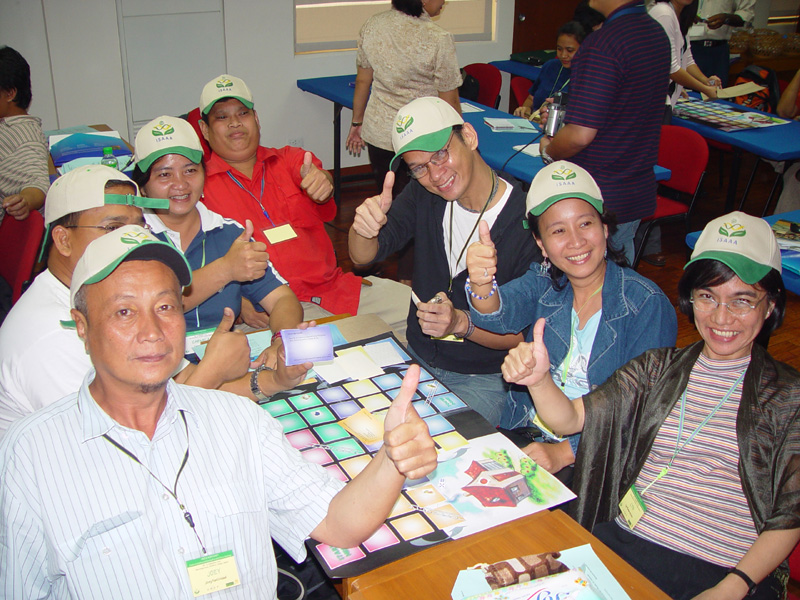
Some
34 media practitioners from print and radio groups
converged in Los Banos, Laguna, Philippines for a
two-day workshop on “Understanding and having fun with
biotechnology.” Organized and facilitated by
the SEARCA Biotechnology Information Center in Los
Banos, in tandem with the International Service for
the Acquisition of Agri-biotech Applications SEACenter,
the participants had an interactive updating on biotechnology
through games, expert sharing sessions, laboratory
exercise on isolating the DNA, and greenhouse tour
of research activities related to biotech. A board
game K-Quest was developed especially for the group
which simulates the regulatory process that a biotech
crop undergoes from the laboratory to farmers' fields
in the Philippines. Co-sponsors were the Agricultural
Biotechnology Support Project II, and the Philippine
Science Journalists Association Inc. More details
regarding the workshop may be obtained by emailing
Sonny Tababa,
SEARCA-BIC administrator, at spt@searca.bic.org. |
|