GLOBAL
MONSANTO AND LANDEC ENTER AGREEMENT
Monsanto Company and Landec Company recently announced two separate agreements that are expected to broaden their reach and product offerings to U.S. farmers. In the first transaction, Monsanto's American Seeds, Inc. (ASI) subsidiary announced that it has acquired Landec's direct marketing and seed sales company, Fielder's Choice Direct (FCD). Under the agreement, ASI will acquire FCD's customer call center operation, which serves customers across the Midwest and is the largest telemarketer of corn seed sales. ASI will also acquire Landec's two seed brands: Fielder's Choice Direct and Heartland Hybrids.
The second agreement involves a five-year global technology license agreement for Landec's Intellicoat® polymer seed coating technology. Under the five-year agreement, Monsanto will become the exclusive sales and marketing agent for Landec's Intellicoat seed coating technology in corn, oilseeds and cotton. Monsanto also receives an option to buyout the Intellicoat seed coating technology.
Landec's Intellicoat seed coating technology has ability to delay seed germination until the soil reaches the optimal temperature. This approach offers farmers the option to expand their planting window, lower on-farm costs, and reduce the risks associated with late planting.
“We're pleased that Monsanto will have worldwide use of our Intellicoat temperature-activated seed coating technology for the coating and treating of a wide variety of seeds," said Steele.
Readers can access the complete press release at http://www.monsanto.com/monsanto/layout/media/06/12-04-06.asp.
TURNING WASTE INTO PAPER THROUGH BIOTECHNOLOGY
The sugar refining industry produces a great volume of fibrous waste-product known as bagasse. A part of the waste produced is recycled as raw material for paper manufacture, but the industrial processing required to break down lignin and for the bleaching of the resulting paper pulp can be damaging to the environment. Research scientists from the IRD and INRA turned to biotechnology for an alternative, biologically based, solution.
From a culture of the filamentous fungus Pycnoporus cinnabarinus, scientists have recovered a delignifying enzyme known as laccase. This enzyme breaks down the lignin in the fibers of bagasse, transforming this waste product, after mechanical refining, into paper pulp. The pulp obtained becomes bleached as the lignin progressively disappears. P. cinnabarinus naturally sythesizes only small amounts of laccase when it grows on bagasse; it is therefore necessary to add volatile agents such as ethanol, in order to increase production of the enzyme under these conditions. Preliminary laboratory trials show that this integrated bioprocess can be adapted to other potential fiber-yielding materials such as wood, bamboo, reeds, and cereal straw, opening up promising applications for the paper industry.
To read more: http://www.ird.fr/us/actualites/fiches/2006/fas252.pdf
A FUTURE POWERED BY FUEL FROM PLANTS
The notion of living plants as “solar cells” intended to capture the infinite energy of the Sun seems ideal; the problem is, plants are not as efficient as solar cells in storing a watt or two of electricity. But plants make up for that inefficiency with their low cost and their benefits to the environment. Plants use up carbon dioxide throughout their development and convert the carbon, along with the Sun’s energy, into stable organic compounds. This means that the Sun's energy is made available at a later date when the Sun isn't shining. Although plants may never be the total answer to our global energy problems, they have substantial potential as a source of carbon-neutral fuel for the transportation sector.
The scientific journal Nature is devoting this week’s Business Feature to biofuels, to explore their contribution to global energy needs in three different areas. Emma Marris examines a biofuel success: the Brazilian sugar-cane ethanol industry in “Sugar cane and ethanol: Drink the best and drive the rest”. The second feature, “US biofuels: A field in ferment” by Katharine Sanderson explores the role of other widely untapped sources of cellulose such as farm waste and poplar plantations that can also be utilized for the production of ethanol and other alcohols. In the third feature “Liquid fuel synthesis: Making it up as you go along” Heidi Ledford analyses a different approach to biofuels – the thermochemical route – to produce fuel from biomass, and specifically, liquid hydocarbons from solid coal. .
Subscribers can access the articles at http://www.nature.com/nature/journal/v444/n7120/index.html#bnf
AFRICA
WARDA WINS UN AWARD
The African Rice Center has been selected as the recipient of the 2006 United Nations Award for South-South Triangular Partnership, an award presented to individuals or institutions for “spearheading, transforming, empowering, mobilizing and/or expanding the South-South agenda by increasing human and financial resources of the South through partnership for development.”
WARDA is being recognized for its New Rice for Africa (NERICA) initiative, which acts as a broker for North-South partnerships in order to create hybridized varieties of rice applicable to conditions in the South. The groundbreaking work on the NERICAs was carried out by an international research team led by former WARDA scientist Dr. Monty Jones, the first African to win the World Food Prize.
“This prestigious award gives us additional encouragement and inspiration to serve Africa better by harnessing the best of science and technology through productive partnership,” said WARDA’s Director General Dr. Papa Abdoulaye Seck.
To read more, visit http://www.warda.org/warda/newsrel-UNAward-dec06.asp.
NEW VEGETABLES OFFER FRESH HOPE FOR AFRICA
Sub-Saharan Africa is the only major region in the world where poverty is increasing rather than decreasing, and where human development indicators are worsening. Investments in agriculture could bring significant improvements in the livelihoods of the people in the area. To assist African development through agriculture, the World Vegetable Center (AVRDC) and the Bill & Melinda Gates Foundation will team up on a project that aims to produce new vegetable varieties and establish vegetable seed sectors in sub-Saharan Africa.
“Vegetables have the highest potential for creating jobs and additional income among the various types of food crops, and can foster rural development”, says Thomas Lumpkin, the Center’s Director General. “The enhanced consumption of vegetables and the greater dietary diversity they provide can also help to alleviate micronutrient malnutrition that is a cause of chronic diseases, blindness and weakened immune systems particularly among children and mothers. Vegetables are one of the most cost-effective and sustainable solutions to micronutrient deficiencies which affect far more people than hunger alone.”
Read the news release at http://www.avrdc.org/news/06BillMelinda_Gates_grant.html.
THE AMERICAS
NEW SOYBEAN GETS NITROGEN FROM SOIL, NOT AIR
A non-transgenically modified soybean variety that improves recovery of nitrogen from land-applied animal waste has been developed and released by the Agricultural Research Services of the United States Department of Agriculture (USDA-ARS). If developed into a new cultivar, the new soybean variety, called Nutrasoy, could become an ideal candidate for animal producers managing waste generated by their operations.
Commercial nodulating soybean varieties utilize the free nitrogen from air through bacteria that thrive in the plants' root nodules in soil. The bacteria turn nitrogen gas into nitrogen fertilizer that the plant can use to make proteins. Nitrasoy, on the other hand, is a non-nodulating soybean germplasm that requires soil-applied nitrogen for excellent seed yield. Its capacity to recover applied nitrogen from soil reduces the risk of possible nitrate pollution of groundwater.
Nitrasoy seed has been deposited in the National Center for Genetic Resources Preservation and the National Plant Germplasm System. Nitrasoy seeds are available for research purposes from the ARS lab in Raleigh, North Carolina.
The complete article can be read at http://www.ars.usda.gov/News/docs.htm?docid=1261.
PEW INITIATIVE SURVEY: PUBLIC OPINION ABOUT GM FOODS STILL ‘UP FOR GRABS’
Public awareness and understanding of genetically modified (GM) foods remains relatively low and consumers’ opinions about GM foods are as divided now as they were five years ago, according to a new survey released this week by the Pew Initiative on Food and Biotechnology. The announcement of survey findings marks the fifth year that the Pew Initiative has monitored public understanding of and support for different types of biotechnology.
“In polls conducted over the last five years, we continue to see that public opinion remains ‘up for grabs’ on GM foods,” said Michael Fernandez, executive director of the Pew Initiative on Food and Biotechnology. “Still generally uncertain about GM foods, the U.S. public has consistently supported strong and clear federal regulations to ensure that these products are safe. How the next generation of biotech products is introduced – and consumers’ trust in the regulation of GM foods – will be critical in shaping U.S. attitudes in the long term.”
Among the most noteworthy findings are:
- Americans hold mixed attitudes towards GM foods. Consumers are generally uncertain about the safety of GM foods, although opinions can shift with new information
- Awareness of GM food has declined over the last five years
- Although Americans are not well informed about animal cloning – they are overwhelmingly uncomfortable with it
- Americans support regulation of GM foods. The survey reveals that regulation may increase confidence in GM foods
- Friends and family are the most trusted sources of information about GM foods
To view a summary of the findings from the survey, go to: http://pewagbiotech.org/research/2006update/.
ASIA AND THE PACIFIC
IMPROVING POTATO PRODUCTION IN AFGHANISTAN
The International Potato Center (CIP) in collaboration with the International Center for Agriculture Research in the Dry Areas (ICARDA) and with USAID-RAMP (Rebuilding Agricultural Markets Program) funding, has recently completed a project in Afghanistan to produce good quality potato seed for resource poor farmers by developing in-country seed production programs. The fruit of this labor is the over 3000 tons of healthy potato seed produced in Afghanistan. The goal of the project is to produce more food to reduce hunger, alleviate poverty, improve living standards of rural people and reduce the area under illicit crop production.
Using a ‘flush out’ approach, CIP initially created a sustainable seed system in Nangarhar province. Quality potato seed imported from India and Pakistan was planted by 25 CIP-trained farmer-seed-multipliers. The seed produced was used in the RAMP-funded project, along with fresh supplies from the region, to replace the existing unhealthy material farmers were using. Linkages are being developed to sell good quality seed in zones that do not produce their own seed. The approach taken is expected to increase potato production and farm income substantially by enhanced productivity of quality potatoes.
CIP and ICARDA are jointly working to achieve a targeted production of 54,000 tons of potato seed by 2009 in Afghanistan in order to hand over the entire potato seed production program to the Ministry of Agriculture, Animal Husbandry and Food (MAAHF) in the next few years.
The complete press release can be read at http://www.cipotato.org/pressroom/press_releases_detail.asp?cod=27.
FARMERS DISCUSS SUSTAINABILITY OF FARMER ASSOCIATIONS
Adequate access to information pertaining agricultural advances, both in conventional, organic and modern biotechnology fields, is an essential requisite to achieve food security in increasingly harder environmental conditions and in views of the shrinking availability of agricultural land. In addition, as a majority of small scale farmers in developing countries often lack enough food for themselves, appropriate access to information is also an important tool for the alleviation of poverty. In addition, farmers are the end users of novel agricultural applications, and small scale farmers represent the majority of the adopters of biotech crops, therefore their experiences are highly valuable not only for other farmers, but for the entire community as a whole.
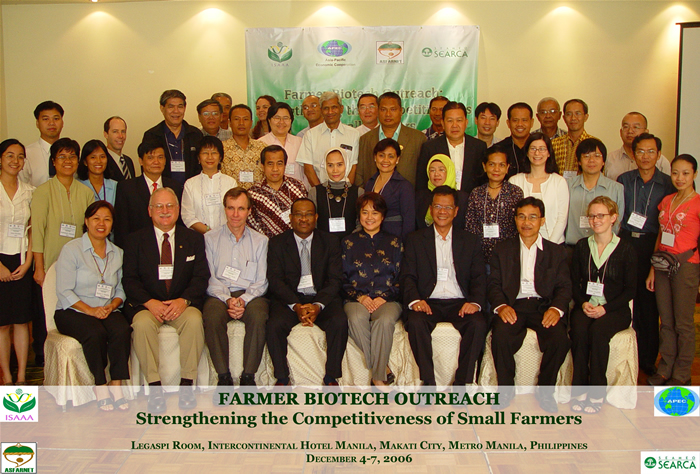
Farmers are arguably the best source of information for other farmers, and farmers are also in the position to best defend their collective interests. How can farmers organize themselves in sustainable organizations/networks to access, share and provide information on novel biotechnology applications? This was the topic of a workshop for farmer leaders of the ASEAN region, which concluded this week in Manila, Philippines. The workshop follows on the steps of a workshop carried out in 2003 that resulted in the establishment of ASFARNET (Asian Farmers Regional Network). Participants from Philippines, Indonesia, Malaysia, Vietnam, Thailand, China and India shared their experiences since the creation of ASFARNET and explored possibilities to ensure their sustainability in views of the limited availability of funds.
The experience of the Philippines suggests a possible strategy of identifying existing national farmers’ organizations to ride on a network’s visibility, to best avail of the existing resources, and to gain access to sources of fund and opportunities. ASFARNET Philippines has operated for three years under the umbrella of PhilMaize, but is now sufficiently strong and has become a legal entity in its own right.
The workshop was organized by the International Service for the Acquisition of Agri-biotech Applications (ISAAA), the SEAMEO Regional Center for Graduate Study and Research in Agriculture (SEARCA), and ASFARNET under the auspices of Asia Pacific Economic Cooperation (APEC).
For more information, email Randy Hautea, global coordinator of ISAAA at r.hautea@isaaa.org.
EUROPE
COMMITTEE FAILS TO ACT ON GM POTATO PROPOSAL; DOSSIER GOES TO COUNCIL
The Regulatory Committee set up to act on a Commission proposal to place on the EU market a new GM starch potato failed to reach a conclusion, and it is now up to the European Council to decide on the matter. If after three months the Council does not reach a position, the proposal comes back to the Commission for final adoption. The said proposal aims to authorize the GM potato EH92-527-1 for cultivation and industrial starch production and not for use as food and feed. The European Food Safety Authority (EFSA) earlier concluded that the GM potato was as safe as conventional potato and unlikely to produce adverse effects to human health or environment.
For the press release, visit http://europa.eu/rapid/pressReleasesAction.do?
reference=MEX/06/1205&format=HTML&aged=0
&language=EN&guiLanguage=en.
UK APPROVES RESEARCH TRIALS OF BLIGHT-RESISTANT POTATO
The United Kingdom’s Department for Environment, Food and Rural Affairs (DEFRA) recently allowed BASF to undertake research trials of a genetically modified (GM) disease-resistant potato developed by the company. The trials will take place on two sites in England, starting in 2007. The GM potato is engineered with resistance against late potato blight, a significant disease problem for UK potato growers who normally combat it by applying chemical fungicides. The research trials will test the effectiveness of the potato's resistance against UK strains of the disease. Similar trials are already underway in three other European countries.
Precautionary conditions have been attached to the statutory consent to ensure that GM material does not persist at the trial sites and that harvested GM potatoes will not be used for food and animal feed. “Our top priority on this issue remains protecting consumers and the environment, and a rigorous independent assessment has concluded that these trials do not give rise to any safety concerns,” said Environment Minister Ian Pearson.
Readers can access the complete news release at http://www.defra.gov.uk/news/latest/2006/farm-1201.htm.
RAPD MARKERS ASSOCIATED WITH BLACKLEG RESISTANCE IN BRASSICA
Blackleg, caused by the fungus Leptosphaeria maculans, is a serious disease of Brassica species. One of the symptoms of blackleg is the dark coloration of the stem of infected plants. Yield loss (grain and oil) occurs when more than half of the cross-section of the stem is discolored. A number of different sources of genes which confer complete resistance to blackleg disease are now being tested. Scientists at the Alabama A&M University used random amplification of polymorphic DNA (RAPD) technique to identify molecular markers associated with resistance to the disease. Their findings are reported in the article “RAPD markers associated with resistance to blackleg disease in Brassica species” of the African Journal of Biotechnology.
Genetic analysis of resistance to blackleg was carried out with 24 genotypes from the USDA Brassica germplasm collections and 9 cultivars from the National Winter Canola Variety Trials (NWCVT). All genotypes were screened for blackleg disease at the juvenile stage and determined that almost half of the genotypes were resistant. On the other hand, adult plant screening revealed that all the NWCVT genotypes were resistant to the disease. Researchers subsequently screened all genotypes to identify molecular markers associated with resistance to blackleg, and identified five that can be used for selection for the resistance trait.
The full article is available at http://www.academicjournals.org/AJB/PDF/
pdf2006/16Nov/Ananga%20et%20al.pdf.
APPLES WITH HIGHER ANTHOCYANINS
Anthocyanins are pigments responsible for the red, purple, and blue colors of many fruits, vegetables, and flowers. These pigments function as pollinator attractants and as light attenuators to protect plant cells from light damage. Aside from acting as a “sunscreen” anthocyanins also serve as powerful antioxidants, which help protect organisms from free radicals formed by UV rays. Because of these benefits conferred by the pigments to both producers and consumers, researchers from Australia studied gene regulation of anthocyanin biosynthesis in red apples, and the results are reported in the journal Plant Physiology.
Researchers isolated a gene encoding an transcription factor from apple (cv Cripps’ Pink). Analysis of the deduced amino acid sequence suggested that this gene regulates anthocyanin production in other plants. The expression of the gene in both Arabidopsis plants and cultured grape cells induced the synthesis of pigments. In ripening apple fruit the transcription of the gene was correlated with anthocyanin synthesis in red skin sectors of fruit. Gene transcripts were more abundant in red skin apple cultivars compared to non-red skin cultivars.
The results show that the gene regulates genes needed for anthocyanin production, and the expression level of this regulator determines apple skin color. The abstract of the article “Light-Induced Expression of a MYB Gene Regulates Anthocyanin Biosynthesis in Red Apples” is available at http://www.plantphysiol.org/cgi/content/abstract/142/3/1216?
maxtoshow=&HITS=10&hits=10&RESULTFORMAT=&fulltext=apple
&searchid=1&FIRSTINDEX=0&volume=142&issue=3&resourcetype=HWCIT.
MULTIGENE PLANT TRANSFORMATION USING THE GATEWAY SYSTEM
Chinese scientists have reported a modified cloning method that will help simplify multigene engineering (introducing several genes at once) in plants and other organisms. Qi-Jun Chen and colleagues wrote in the journal Plant Molecular Biology that the modified system, called MultiRound Gateway, is simple, efficient, and more flexible than existing methodologies of multigene engineering. They were able to use the Gateway technology to introduce seven functional genes into a plant expression vector. Before them, no one has tried using the vector system to link or fuse multiple transgenes.
The Gateway technology is a universal cloning method that allows assembly and cloning of multiple DNA segments using the λ phage site-specific recombination. The modified system presented by Chen and colleagues follows multiple rounds of the two-component Gateway recombination cloning. With the modified method, multiple transgenes can be delivered sequentially into a Gateway-compatible destination vector.
The research abstract, with links to the full paper for subscribers, can be accessed at http://www.springerlink.com/content/n730724570570804.
| A
N N O U N C E M E N T S |
INTERNATIONAL CONFERENCE ON PLANT MOLECULAR BREEDING
The 2nd International Conference on Plant Molecular Breeding (ICPMB) will be held on March 23-27, 2007 in Sanya, Hainan province, China. This event will focus on applied plant genomics and molecular plant breeding in view of the increasing need to use new molecular approaches and mine novel gene resources. Important aspects of plant molecular breeding and related transgenic ecological risk and intellectual property right (IPR) will be covered in several sessions and satellite workshops.
For more information, visit http://www.icpmb.org/142.html.
FOCUS ON COMPLIANCE: COTTON
A workshop that will assist agricultural stakeholders to comply with United States federal requirements for regulated field trials of cotton is scheduled on January 9, 2007 at New Orleans Marriott in Louisiana. The session will address the responsible use of plant biotechnology during the research and development phase that precedes product commercialization.
For more information, contact biocomplianceworkshops@bio.org or visit biocomplianceworkshops@bio.org.
BIOTECHNOLOGY BUSINESS FORUM IN SOUTH AFRICA
The Biotechnology Business Forum, organized by the Institute for International Research (IIR) South Africa, will be held on March 13-15, 2007 in Johannesburg, South Africa. The forum is a case study-driven event focused on operational strategies, technologies, regulatory changes, manufacturing production and process development. Participants will gain extended insight into biotech funding opportunities and their implications, find out about Biotechnology business development strategies, discover biotechnology opportunities and challenges, and debate biotechnology regulation and legislature and its effect on biotech businesses.
For more information, visit http://www.iir-conferences.co.za/eventInfo.php?e=1244.
INTERNATIONAL CONFERENCE ON INDIGENOUS VEGETABLES AND LEGUMES
The First International Conference on Indigenous Vegetables and Legumes (IVs 2006) will be held next week, 12-15 December 2006 in Hyderabad, India. AVRDC (The World Vegetable Center), the Bioversity International (formerly IPGRI), the International Crops Research Institute for the Semi-Arid Tropics (ICRISAT), and the International Society for Horticultural Science (ISHS) helped organized the upcoming event. Among the topics to be discussed include germplasm conservation and biodiversity, genetics, breeding and biotechnology.
More information at http://www.ivs2006.org
|