* Global * WTO RULES IN FAVOR OF BIOTECHNOLOGY
The World Trade Organization (WTO) ruled last week in favor
of the United States, Argentina, and Canada in their WTO
case against the European Union (EU) over its moratorium
on approving agricultural biotech products. The WTO has also
challenged product bans imposed by six EU Member States (Austria,
France, Germany, Greece, Italy, and Luxembourg) on seven
of the biotech crops approved by the EU prior to the adoption
of the moratorium. In each case, the panel upheld claims
that in light of positive safety assessments issued by European
scientists, the Member State bans were not supported by scientific
evidence and were thus inconsistent with WTO rules.
“Today's decision affirms what the world's farmers
have known about biotechnology for many years,” said
US Agriculture Secretary Mike Johanns. “Since the first
biotechnology crops were commercialized in 1996, we've seen
double-digit increases in their adoption every single year.
Biotechnology crops not only are helping to meet the world's
food needs, they also are having a positive environmental
impact on our soil and water resources. Farmers who grow
biotechnology crops in 21 countries around the world, including
5 in the EU, stand to benefit from today's decision.”
To read the WTO Reports of the panel that
examined complaints by the United States, Canada and Argentina
(DS291, DS292
and DS293) against “European Communities — Measures
affecting the approval and marketing of biotech products” visit:
http://www.wto.org/english/news_e/news06_e/291r_e.htm.
With reports from: http://www.usda.gov/wps/portal/
!ut/p/_s.7_0_A/7_0_1OB?contentidonly=true&contentid
=2006/09/0389.xml
G77 MEETS, ORGANIZES ON SCIENCE DEVELOPMENT
Once the Third World Network of Scientific Organizations,
the TWNSO is now the Consortium on Science, Technology and
Innovation for the South (COSTIS), and aims to put science
and technology development on the agenda of governments in
the developing world. This was decided upon by the Ministers
of Science and Technology of the Group of 77 and China, which
met on the occasion of the 10th General Conference of the
Academy of Sciences for the Developing World (TWAS) and the
9th General Assembly of the TWNSO, held recently at Angra
dos Reis, Rio de Janeiro, Brazil.
The ministers emphasized the need to continue strengthening
South-South operation in order to develop science and technology
policy. Among the strategies proposed are increasing regional
cooperation on science and technology, increasing funding
for research and development in support of national growth,
placing science and technology on the national as well as
the international development agenda, creating synergies
between public and private support for science and technology,
and eliminating illiteracy while promoting higher education
and the creation of infrastructure for research and development
as a way to prevent brain drain.
“We should not be forgetting the gains made in the
field of science and technology and the potential benefits
in areas such as nanotechnology, biotechnology, health technologies
and water technologies,” H.E. Mosibudi Mangena, Minister
of Science and Technology of South Africa, said in his opening
statement, “In this regard, we should continue with
knowledge sharing, investment in research and development
for poverty alleviation, including the research and development
strategies in these key sectors. We should continue to have
the dialogue, which speaks for the scientific community,
particularly from the South.”
Read the complete releases at http://www.g77.org/
mmst/conclusion.html and http://www.g77.org/mmst/
statement1.html.
RODENTS GET VITAMIN A BOOST FROM NEW BIOFORTIFIED MAIZE
Scientists from the University of Wisconsin report that
maize bred to contain high concentrations of beta-carotene
has indeed increased the Vitamin A status in gerbils. The
study, published in the October issue of the Journal of Nutrition,
reports that liver Vitamin A levels were 150% greater in
gerbils fed with the maize than those of the control group,
and equaled that of the group receiving the beta-carotene
supplements.
The authors, Julie Howe and Sherry Tanumihardjo, also suggest
that this biofortified maize could be used to tackle Vitamin
A deficiency (VAD), a serious health problem in more than
50% of all countries, especially in Africa and South-East
Asia.
Read
the complete press release at http://www.nutraingredients.com/news/ng.asp?n=70826-
syngenta-beta-carotene-vitamin-a-deficiency-biofortication.
Subscribers to the Journal of Nutrition can read the complete
article, “Carotenoid-Biofortified Maize Maintains Adequate
Vitamin A Status in Mongolian Gerbils,” at http://jn.nutrition.org/cgi/content/abstract/136/10/2562.
GLOBAL BIOENERGY PARTNERSHIP SECRETARIAT UP TO PROMOTE BIOENERGY
The Food and Agriculture Organization (FAO) has been chosen
to host the GBEP (Global Bioenergy Partnership) Secretariat.
GBEP was launched in May 2006 to promote the use of bioenergy,
with particular focus on developing countries. In the light
of high oil prices, concerns on diminishing fossil fuel reserves,
and global warming, there is a growing need to develop renewable
energy sources. The overall aim of the Partnership is to
respond to these needs through the development of biofuels
as renewable energy sources.
Alexander Muller, FAO Assistant Director-General
for Sustainable Development, hopes that the “positive synergies between
GBEP and FAO’s International Bioenergy Platform (IBEP)
will contribute to an expanded and sustainable role of biofuels.” FAO
has been known to be actively promoting biofuels as a means
of reducing poverty while producing clean low-cost energy.
The Secretariat will be the principal coordinator of Partnership
communications and activities, and will assist international
exchanges of know-how and technology, promote supportive
policy frameworks, and identify ways of fostering investments
and removing barriers to the development and implementation
of joint projects.
Italy
and Mexico were appointed as Chair and Vice-Chair, respectively,
of GBEP’s Steering
Committee for the next two years. The full press release
can be accessed at
http://www.fao.org/newsroom/en/news/2006/
1000405/index.html.
MOUSE MODEL DEVELOPED TO TEST GM FOOD ALLERGENICITY
Scientists from Michigan State University (MSU) have developed
a mouse model to test the allergy-causing potential of genetically
modified foods. The researchers, led by Venu Gangur, assistant
professor of food science and human nutrition, have received
a $447,000 grant from the Environmental Protection Agency
(EPA) for their work.
The potential of GM foods to cause allergic reactions in
humans is a major concern when evaluating the biosafety of
GM crops. Although there are already protocols in place to
make assessments association with such issues, there has
hitherto been no definitive test of GM food allergenicity.
The MSU scientists will use the grant to verify whether the
model works on a variety of proteins. If successfully validated,
the testing could be available commercially in about five
years.
Read the complete press release at http://newsroom.msu.edu/
site/indexer/2864/content.htm.
MILKEN INSTITUTE RELEASES REPORT ON BIOTECH IN UNIVERSITIES
Five United States universities topped 683
universities worldwide for their ability to turn biotechnology
research
into licensing income and business startups. These were Massachusetts
Institute of Technology, University of California system,
California Institute of Technology, Stanford University,
and University of Florida. According to a report “Mind
to Market: A Global Analysis of University Biotechnology
Transfer and Commercialization released by the nonprofit
Milken Institute, US universities dominated the top 50 of
the universities studied.
Milken Institute examined the biotechnology transfer process
in universities from knowledge creation to technology transfer
and early-stage commercialization. Among the key findings
were:
* Harvard University ranks first in terms of biotech research,
as measured by papers and citations, followed by the University
of Tokyo and University of London.
* The University of Texas system scores first on the Biotech
Patent Composite Index, followed by U.C. San Francisco. The
University of London ranks first among foreign universities
(10th overall).
* Among U.S., Canadian and European universities, the United
States leads in invention disclosures, patents filed and
granted, licenses executed and licensing income. However,
European universities surpass their U.S. counterparts in
startups established.
* Research activity has a high rate of return. Each 10-point
increase in research papers score contributes an additional
$1.7 million in annual licensing income.
* Investments into offices of technology transfer (OTT)
also offer high returns. For every $1 invested in OTT staff,
the university receives a little more than $6 of licensing
income.
Read more on the Milken report at http://www.milkeninstitute.org/publications/m2m.html
ICRISAT TOUTS POTENTIAL OF BIOFUELS
The world’s drylands can contribute
to a bio-fueled future, and the challenge and opportunity
for those interested
in developing biofuels are to ensure that the dryland poor
are not left behind. This was stated by Dr. William Dar,
Director General of the International Crops Research Institute
for the Semi-Arid Tropics (ICRISAT), in a document now available
on the ICRISAT website.
Dr. Dar takes a look at the prospects of
developing bioethanol and biodiesel in India, both of which
are attractive alternatives
to increasingly expensive fossil fuels. The cost of ethanol
production is no constraint; rather, it is the supply of
raw materials for production that is hampering India’s
ethanol industry. This is where ICRISAT and partners come
in: instead of using leftover molasses from sugar refining,
ICRISAT is working on sweet sorghum. This little known dryland
crop stores large quantities of energy as sugar in its stalk
while producing reasonable grain yields. This sugar can be
fermented into ethanol more cheaply than from molasses and
with even greater energy savings compared to maize grain.
As in bioethanol, raw materials are in short supply for
biodiesel in wasteland areas. ICRISAT is working with a private
company on the possibility of using sweet sorghum, along
with two other dryland species that can contribute to better
biodiesel production: Pongamia pinnata, a leguminous tree
adapted to wetter wastelands with problem soils; and Jatropha
curcas, a more drought-tolerant shrub adapted to well-drained
wastelands. Both produce fruits containing about 35% oil
suitable for bio-diesel.
Find out more about ICRISAT at http://www.icrisat.org.
* Africa *
PHILANTHROPIST DONATES TO MILLENNIUM ALLIANCE
George Soros announced recently that he has pledged $50
million to help the Millennium Promise Alliance. Soros is
a financier, as well as chairman of the Open Society Institute,
a private operating and grant-making foundation.
The gift will go to support Millennium Villages, which are
composed of roughly 5,000 people, and which take a private
investment of $300,000 a year, for five years to complete
the project. Funds are used to provide practical and proven
interventions aimed at meeting the Millennium Development
Goals like bed nets to prevent malaria; fertilizers to replenish
depleted soils; school lunches for malnourished children;
treatment for people living with HIV/AIDS; and other tried-and-true
approaches to controlling the symptoms and effects of extreme
poverty. Millennium Promise is working in more than 75 villages
in ten different countries: Ethiopia, Ghana, Kenya, Malawi,
Mali, Nigeria, Rwanda, Senegal, Tanzania and Uganda.
Read
the complete press release at http://www.millenniumpromise.org/site/
PageServer?pagename=about_supporters.
JATROPHA SHIPMENT ARRIVES IN NAMIBIA
According to Namibia’s New Era, the first large consignment
of Jatropha seeds have arrived in the country from India.
After having looked at other alternative fuel sources such
as plant oils from sunflower, canola, soy, or cotton, local
experts have determined that oil from Jatropha carcus is
the most viable option for Namibia. Jatropha is well suited
to the country’s climate, as it thrives under hot conditions
and is able to survive long periods of drought.
With reports from http://www.newera.com.na/. Read the complete
article at http://allafrica.com/stories/
200609250081.html.
* The Americas *
A
DIFFERENT BREED OF TOOLKIT – THE SOYBEAN BREEDER’S
TOOLBOX
Scientists at the Agricultural Research Service
(ARS) recently unveiled an online database, which they
hope soybean breeders,
producers, and scientists will use in their research. “The
Soybean Breeder’s Toolbox” makes it easier to
compare current soybean genetic maps and will allow study
of maps from other legume species when they become available.
Molecular markers on genetic map, and diseases and insects
that attack soybean plants are only a few of the topics that
can be sourced from the database. Also in the online toolkit
are data associated with soybean quantitative traits, such
as resistance of different soybean genotypes to biological
and environmental stresses. The toolbox’s linkage with
other databases will also make it possible to combine information
from other databases into a single report. The website is
the new interface to SoyBase, a pioneering, ARS-supported
plant-genetic database established in 1993.
Access the database at http://soybase.org/. View the complete
press release at http://www.ars.usda.gov/
is/pr/2006/060925.htm.
* Asia *
NEED
TO BUILD CONSUMERS' CONFIDENCE IN GM CROPS, SAYS
INDIAN AGRIC MINISTER
Sharad Pawar, India's Agriculture Minister, stressed
the need for creating confidence among consumers on
the safety of genetically modified foods during an
inauguration speech for the international conference on “Recent
scientific developments in agricultural bio-technology:
sharing experiences and knowledge”. The event was organized
by the International Life Sciences Institute-India
(ILSI-India) and co-sponsored by Ministry of Agriculture
and Cooperation, Government of India in New Delhi.
Expressing concern over the decreasing availability of water
for agricultural purposes, the Minister underlined the need
for developing transgenic crops tolerant to drought in order
to extend the area under cultivation and consequently increase
total food production. India has taken up an ambitious agricultural
biotechnology program to ensure food security, and is among
the 21 countries in terms of acreage under GM crops. Many
transgenic crops including eggplant, rice, tomato, potato
and pigeon pea, are currently being developed.
For more detailed information visit: http://pib.nic.in/
release/release.asp?relid=21040,
or contact: b.choudhary@isaaa.org
ASIA FARMERS DEVELOPING BETTER MUNGBEAN
With prices of meat higher in developing countries, especially
in Asia, consumers will be turning more and more to alternative
sources of protein. Legumes are a good source of such nutrients,
and mungbean, in particular, has 24% easily digestible protein,
high iron content, and significant amounts of calcium, phosphorus,
and some essential vitamins.
Mungbean is also abundant in many Asian countries. Scientists
in South Asia, in a project supported by the World Vegetable
Center, looked at how mungbean production could be improved
in the region, not only to provide cheap protein but also
to raise the income of farmers. After three years of field
trials and laboratory work, Bangladesh and India were able
to develop and release improved cultivars with high yields
of 1.5 tonnes per hectare, maturing evenly in only 60-65
days. Other varietal features developed were large shiny
seeds and resistance to thrips and mungbean yellow mosaic
virus.
Scientists now aim to work with farmers to produce mungbean
varieties with better drought tolerance for use in marginal
and semi-arid situations. Also in the offing are research
projects on management of insects such as pod borer, white
fly, and weevils; and the control of diseases such as leaf
spot and powdery mildew.
Read the complete feature at http://www.avrdc.org/news/
06Mungbean_fastfood.html.
* Europe *
EC RESPONDS TO GALILEO REQUEST ON GM IN ITALY
The European Commission (EC) will take into
account the request of the Galileo scientific organization
as it looks
at Italy’s current legal framework regarding the planting
of genetically modified (GM) crops. This was the EC’s
response to a recent letter by the organization that expressed
concerns on the progress of GM research because of decrees
in Italy. The letter had asked the EC to intervene to allow
researchers to resume work within rules in collaboration
with other European Union (EU) researchers
The EC, the letter said, is aware of Italy’s
legal framework, and that discussions on co-existence are
ongoing.
The EC has also opened a formal investigation on the ban
on GM cultivation in the country, but since the ban has been
declared by the Italian constitutional court, the investigation
has been closed.
For more information, contact Dr. Bruno Mezzetti at b.mezzetti@univpm.it.
ACROSS THE CHANNEL COOPERATION FOR AGRIC RESEARCH
The National Institute for Agricultural Research of France
(INRA) and the Biotechnology and Biological Sciences Research
Council (BBSRC) of the United Kingdom have launched this
month three joint research projects. These projects, to receive
a total grant of 4 million euros, are the first to be funded
as part of an initiative aimed at encouraging bilateral collaboration
on research on four key crops: wheat, rice, barley and potatoes.
The objective of the program is to transfer the knowledge
derived from the study of model plants, such as the small
weed Arabidopsis, to plants important for agriculture.
“These collaborative programs are crucial to
deepen out understanding in the area of agricultural research.
Climate change and the current trends in food demand and
in emerging diseases render the collaboration with international
partners more crucial than ever, in order to optimize the
exchange of information and the use of the resources”,
said INRA and BBSRC presidents Julia Goodfellow and Marion
Guillou in a joint statement.
Read
the complete press release at: http://www.inra.fr/
presse/projets_recherche_communs_inra_bbsrc
OPINION ARTICLE EXPLORES RICE GENOME SEQUENCE DISCREPANCIES When the complete sequence of the rice genome was validated
and released in 2002, debates arose as to whether the whole-genome
shotgun method used by the Beijing Genomics Institute and
the Syngenta Corporation was better than the map-based sequence
published by the International Rice Genome Sequencing Project
(IRGSP). Because there were some discrepancies, doubts arose
as to which sequence was valid. The validity of the entire
sequence is important, as it will aid in future rice improvement
programs.
In an opinion article in a recent issue of
Trends in Plant Science, Jun Yu and colleagues write about “Comparing
the whole-genome-shotgun and map-based sequences of the rice
genome.” They argue that the most serious differences
between the sequences are mostly found in the large transposable
elements in intergenic regions. Differences in published
gene counts and polymorphism rates are similarly resolved
by considering how transposable elements affect the sequence
analysis, the authors write.
A similar argument arose after the complete
sequence of the human genome was released, but the researchers
say that
different species have to be treated differently. Since there
are some issues with plant genomes, such as the many intergenic
repeats common to cereal crops and changes associated with
breeding, these issues have to be factored into the debate.
Other issues include differing quality standards amongst
laboratories working on the sequences. The researchers also
employ statistics to compare data between the methods, and
contest that once the mentioned issues are factored in, there
is “remarkable agreement in the sequences produced
by these two methods.”
Subscribers to the journal can read the complete article
at
http://dx.doi.org/10.1016/j.tplants.2006.06.005.
CHICKPEA GENE MAKES TOBACCO STRESS TOLERANT
The APETALA2/ethylene-responsive factor (ERF)
family of proteins regulates various processes of development
and metabolism
in plants. Proteins of this family also allow plants to react
to various hormones, which, in turn, are produced in response
to environmental cues, such as temperature and salinity stresses.
This may imply that APETALA2 genes can help plants cope with
stress. Rakesh K. Shukla and colleagues of the National Center
for Plant Genome Research, India found out that “Expression
of CAP2, an APETALA2-Family Transcription Factor from Chickpea,
Enhances Growth and Tolerance to Dehydration and Salt Stress
in Transgenic Tobacco.”
In an article published in a recent issue of Plant Physiology,
the researchers characterized, CAP2, a gene from chickpea,
which was found to encode a novel AP2-family protein. They
analyzed the activity of the gene, characterized the protein;
and then expressed the gene in tobacco.
Through their work, researchers found that: 1) the CAP2 protein bound specifically to a dehydration-responsive element
in a gel-shift assay, which shows that it was directly involved
in plant stress response; 2) levels of CAP2 mRNA increase
by dehydration and by treatment with sodium chloride, abscisic
acid, and auxin, but not by treatment with low temperature,
salicylic acid, and jasmonic acid; 3) When expressed tobacco,
transgenic plants had larger leaves and more lateral roots;
and 4) CAP2 transgenic tobacco shows greater tolerance to
dehydration and salt stress than wild-type plants. Taken
together, the results show that CAP2 can control both plant
growth and development, and allow plants to respond to dehydration
and salt stress.
Subscribers to Plant Physiology can read the complete article
at http://www.plantphysiol.org/cgi/reprint/142/1/113. Other
readers can take a look at the abstract at http://www.plantphysiol.org/cgi/content/abstract/142/1/113.
INRA CALLS FOR PROPOSALS The (INRA) is launching a call for proposals of research
projects for scientists who work in the areas of food, environment,
and agriculture in relation with INRA teams. The selection
of the best projects will be based on 2 criteria: excellence
and scientific originality. The criteria will focus on the
excellence of the host team at INRA; the excellence of the
candidate, without any restriction on nationality; the quality
of the scientific environment; and of the conditions within
the host team. Regarding both the host team and the candidate,
the level of publications and the future of the doctoral
students involved in the project will enable to define these
criteria. The innovative nature and the originality of the
proposed work will also be studied. The deadline for submitting
applications is October 31st, 2006. For further information
and the application form, contact vissac@paris.inra.fr.
FAO TO CONDUCT WORKSHOPS ON AGRI
A workshop on “Enabling Environments
for Agribusiness and Agro-industry Development in Eastern
Europe and Central
Asia will be held from the 30th of November to the 2nd of
December, 2006 in Budapest, Hungary. Organized by the Food
and Agricultural Organization of the United Nations, the
workshop aims to identify, characterize, and assess the set
of policies, institutions, and support services that constitute
the enabling environment for agribusiness and agroindustrial
development in the region; and identify lessons and best
practices from induced changes in policies, institutions,
and support services that have led to increased investments
and improved competitive performance in specific agribusiness
and agro-industry sub-sectors. Read the complete release
at http://www.fao.ORG/regional/SEUR/EE_CA.pdf.
MONSANTO ARGENTINA OFFERS FREE ONLINE BIOTECH COURSES
Monsanto Argentina is offering three online electronic biotechnology
courses free of charge open to anyone wishing to know more
about biotechnology. The first course, Basic Biotechnology,
offers an overview of biotechnology today, explains terms
and definitions, and describes the regulation and requirements
necessary for the commercialization of biotech crops. Two
additional courses, Bt Maize and herbicide resistant Maize
(RR Maize), are open to those who have completed the basic
course. The courses are in Spanish and have an average duration
of one month.
Visit: http://www.monsanto.com.ar/h/cursos.php for more
information.
|
ISAAA & KMA
HOLD WORKSHOP FOR KANNADA MEDIA
ISAAA
along with the Karnataka Media Academy (KMA) recently organized
a one-day media workshop for Kannada and English media in
Bangalore. The entire workshop was conducted in both the
Kannada and English language.
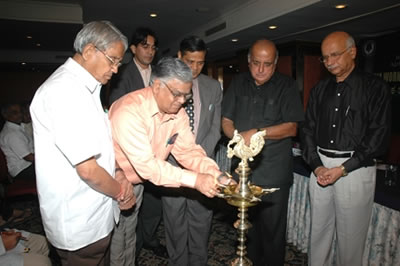
Sh.
Ramachandra Gowda, Minister for Science & Technology,
Government of Karnataka inaugurated the workshop. Others
dignitaries in the workshop included Dr. CD Mayee, Chairman
of the Agricultural Scientists Recruitment Board (ASRB);
Dr. Anup Pujari, Principal Secretary of IT,BT, and S&T
of the Government of Karnataka; Sh. VN Subba Rao, Chairman
of the Karnataka Media Academy; Dr. SR Rao, Advisor-Dept
of Biotechnology (DBT) and Dr. TM Manjunath.
More
than 90 journalists participated in the inaugural session,
and 55 journalists from both Kannada and English media attended
the workshop throughout the day. The registered participants
included 35 Kannada writing reporters from the field across
various parts of Karnataka, and 20 Kannada and English writing
journalists from Bangalore.
For
more information, contact Bhagirath Choudhary of the ISAAA
South Asia Office at b.choudhary@isaaa.org.
| Inaguration |
 |
| Mr. Ramachandra Gowda, Hon’ble Minister for Science & Technology,
Govt of Karnataka, Bangalore
Dr. C. D. Mayee, Chairman, Agricultural Scientists Recruitment
Board, ICAR, New Delhi
Mr. Bhagirath Choudhary, National Coordinator, International
Service for the Acquisition of Agri-Biotech Applications
(ISAAA), New Delhi
Dr. Anup K. Pujari, Principal Secretary, IT, BT and
Science & Technology, Govt of Karnataka, Bangalore
Mr. V. N. Subba Rao, Chairman, Karnataka Media Academy,
Bangalore
Dr. T. M. Manjunath, Workshop Coordinator & Consultant
- AgriBiotech, Bangalore
|
| |
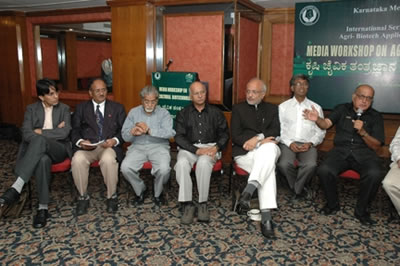
| Panel
Discussion |
 |
| Mr. Bhagirath Choudhary, National Coordinator, International
Service for the Acquisition of Agri-Biotech Applications
(ISAAA), New Delhi
Dr. T. K. S. Gowda, Director (PG Studies), University
of Agricultural Sciences, Bangalore
Prof. C. Kameswara Rao, Secretary, Foundation for Biotechnology
Awareness and Education (FBAE), Bangalore
Dr.
T. M. Manjunath, Workshop Coordinator & Consultant
- AgriBiotech, Bangalore
Dr. S Shantharam, Biologistics International, USA
Dr. M. Udaya Kumar, Head (Crop Physiology), University
of Agricultural Sciences, Bangalore
Mr. V. N. Subba Rao, Chairman, Karnataka Media Academy,
Bangalore
Dr SR Rao, Advisor, Dept of Biotechnology, New Delhi
|
|