GLOBAL
BT NEEDS
HELP TO KILL MOTH
A clean gut means survival for larvae of gypsy moth fed
with Bacillus thuringiensis (Bt), a widely used organic
pesticide. Researchers at the University of Wisconsin-Madison,
USA, counter the wide belief that Bt activity alone is
needed to cause the insects’ death. Scientists determined
that native bacteria in the moth’s gut need to be
present for Bt to be lethal. “Ultimately, this is
a toxin-mediated septicemia (blood poisoning) modulated
by the gut community”, write the authors. The team
published the findings in a recent issue of the Proceedings
of the National Academy of Sciences (PNAS).
Results of the research may have implications in managing
the deployment of the Bt technology. “The work also
raises the possibility that the genes encoding the (Bt)
toxins could be deployed more effectively in transgenic
crops by exploiting the role of insect-borne bacteria that
enhance insecticidal activity,” writes the researchers
in the PNAS report.
Read the complete press release at http://www.news.wisc.edu/12934.html.
To read the abstract of the article “Midgut bacteria
required for Bacillus thuringiensis insecticidal activity” visit:
http://www.pnas.org/cgi/content/abstract/0604865103v1?maxtoshow=&HITS=
NSF
AWARDS $72.5 M FOR PLANT GENOME RESEARCH
The
United States’ National
Science Foundation (NSF) has given 24 new awards totaling
US $72.5 million to support
research about the genomes of economically important crop
plants such as potato, poplar and corn. Awards were given
to 43 institutions in 30 states, including 10 international
collaborations.
“
These innovative new projects will provide the basic discoveries
leading to a greater understanding of how variations
in plant genomes manifest as changes in growth and development
in a range of environments. New discoveries improve
the
quality and yield of crops plants”, says James
Collins, head of the NSF's Biological Sciences Directorate.
Several
new projects will extend the knowledge gained
from the sequenced genomes of some key crops. Comparative
genome
tools will enable researchers to rapidly pinpoint
genes for disease resistance in legumes. Such tools will
be used to study chickpea, cowpea and pigeonpea through
a developing
country collaboration with the International Crops
Research
Institute for the Semi-Arid Tropics in India.
Additional
information on research initiatives to be funded by NSF
are available at http://www.nsf.gov/bio/pubs/awards/pgr.htm or by emailing Jane Silverthorne at jsilvert@nsf.gov.
UNLOCKING
THE SECRETS OF THE OYSTER MUSHROOM GENOME
The
oyster mushroom, Pleurotus ostreatus, will have the distinction
of being the first edible mushroom in the
world to be genetically sequenced. The project was
chosen
from amongst more than 400 entered for the annual competition
of the Joint Genome Institute (JGI) of the United States
Department of Energy’s Science Office. Why a mushroom? Aside from being rich in vitamins and
minerals, the mushrooms are actively involved in recycling
carbon in the environment by degrading lignin, a component
of wood. The degradation of this lignin is an essential
step in the production of biofuels. Mushrooms may also
be recruited for the breakdown of man-made contaminants
released into the environment.
The article, “Sequencing of the oyster mushroom
genome,” can be accessed at
http://www.basqueresearch.com/berria_irakurri.asp?Gelaxka=1_1&Berri_Kod=1046&hizk=I.
AGORA
PROVIDES GLOBAL ACCESS TO AGRIC INFO
The
Food and Agriculture Organization (FAO) recently announced
the launching of
the second phase of the Global Online
Research in Agriculture (AGORA) initiative, which will
provide more countries with access to leading food
and agriculture journals for little or no cost. The public-private
partnership between FAO, some of the world’s leading
science publishers and other key partners including the
World Health Organization and Cornell University, was
formed in response to the needs of thousands of students,
researchers and academics in poorer countries for better
access to important agricultural information.
“In
less than three years, AGORA has already helped bridge
the knowledge gap by providing 850 institutions access
to over 900 journals in the areas of agriculture and
related subjects,” notes Anton Mangstl, Director of FAO’s
Library and Documentation Systems Division. Through
AGORA, public and private sectors are making an important contribution
to the achievement of the United Nations Millenium
Development Goals by providing essential information to improve the
standards of poor countries.
The
news article can be read at http://www.fao.org/newsroom/en/news/2006/1000406/index.html. BIOTECH
RICE FACILITY FOR PHARMA OPENS IN KANSAS
A
new bioprocessing facility for plant-made pharmaceuticals
will open in
Kansas, USA, officials announced recently.
The facility, owned by California-based Ventria Bioscience,
will process genetically-engineered rice for the
extraction of proteins to be incorporated into oral rehydration
solutions to address childhood diarrhea. This disease
claims 1.9 million lives annually according to the
World Health Organization.
“I welcome Ventria Bioscience to Kansas and look
forward to their contributions to the health of children
worldwide”, declared Kansas Governor Kathleen Sebelius
in a statement.
Access the complete release at http://www.ventria.com/news/Press%20Release%209-29-06.asp
FUSARIUM MEETS MATCH IN BACILLUS, AND OTHER FUNGAL STORIES Now here is some good news from the microscopic
world. Researchers in the Agricultural Research Service
(ARS)
Toxicology and Mycotoxin Research Unit at Athens, USA,
have found a bacterium that can greatly reduce the colonization
of corn by the fungus Fusarium verticillioides. This fungus
is one of the sources of mycotoxins – known carcinogens,
the presence of which lowers the marketability of crops.
ARS microbiologist Charles Bacon and colleagues observed
that one microbe that also lives in corn can protect the
crop from fungi. Bacillus mojavensis, already patented
by ARS, greatly reduces the amount of fungus in corn. Unfortunately,
the bacillus is killed by fusaric acid, a substance secreted
by the fungus when stressed. However, the researchers identified
two mutant bacterial strains resistant to fusaric acid,
which may provide the biocontrol tools needed for better
crop protection.
ARS scientists are also are also taking
apart the toxin-making machinery of Fusarium, to determine
which genes are employed
by the fungus to produce mycotoxins. To this aim, a team
led by David Kendra started compiling the equivalent of “genetic
snapshots” of the fungus in 2001. Currently, 80 %
of the fungal genes have been identified, and scientists
have also discovered a new gene, FUM20, plus nine others
that may regulate mycotoxin production. This information,
argues Kendra, will help to formulate sprays that disrupt
the fungus’ toxin synthesis, or the formation of
critical spore pigments.
Read more about these projects at: http://www.ars.usda.gov/is/pr/2006/061002.htm and http://www.ars.usda.gov/is/pr/2006/061005.htm
BIOTECH TOMATOES FOR EDIBLE MALARIA VACCINES?
Malaria affects 300–500 million people
annually, and over two billion individuals reside in
areas where
the disease is endemic. A proposal to deliver malarial
vaccines using tomatoes, published recently in the journal
Medical Hypothesis, was forwarded by Kamal Chowdhurya and
Omar Bagasra at Chaflin University, South Carolina. Tomatoes
with different antigens for malaria would be identified
by the different fruit sizes, shapes and colors. By using
edible vaccines, the authors hope that the logistical difficulties
in immunizing over a million children living in malaria
prone areas can be overcome, at a fraction of a cost of
a regular vaccination.
“Our hypothesis is to immunize the children/infants
by feeding them one variety of tomato at a time, 3–6
weeks apart”, said the researchers. The researchers
expect that the low dose of antigens that are administered
should be enough to trigger an immune response, protecting
the children from the malarial parasite in the future.
Several challenges need to be resolved before tomato can
be used to produce these biopharmaceuticals. Among these
include the development of tomato lines with consistent
high gene expression levels; and conducting studies assessing
the risks of out-crossing among the transgenic crop and
their close relatives via pollination.
For more details, the complete paper can be accessed online
by subscribers at http://dx.doi.org/10.1016/j.mehy.2006.04.079
AFRICA HARVESTING RAINWATER FOR AGRIC IN AFRICA
Solutions
to global water scarcity may lie, not so much in places
where this resource is still
abundant, but in
a region that is relatively dry – the African savannas.
This
was one of the key findings of the Comprehensive Assessment
of Water Management for Agriculture, a study carried
out to examine the current status of water availability
worldwide.
According to the International Water Management Institute
(IWMI) Director General Frank Rijsberman, the African
savannas can be made more productive using the limited
water supply
already at hand, citing the example of Brazilian scientists
who accomplished such feat in their country’s vast
savanna. If Africa is to feed itself it would have
to harvest more rainwater- not in dams, but in pails
and buckets. To transform
rain-fed agriculture in the African savannas and other
semi-arid lands would require investment in low-cost practices
such as supplemental irrigation and water harvesting with
simple equipment. For the world’s poor who live in
semi-arid tropics, this transformation should be done soon
since “there simply is not enough water to go around,” said
David Molden, an IWMI scientist who led the research.
Read the complete article at http://www.cgiar.org/monthlystory/october2006.html.
AMERICA SYNGENTA’S
ROOTWORM BIOTECH MAIZE APPROVED IN THE USA
Syngenta announced this week that its maize
rootworm trait, Agrisure™ RW, has received registration
approval from the US Environmental Protection Agency
(EPA). The
seeds will be available in US markets for the 2007 growing
season, as a single trait and stacked with glyphosate tolerance
through elite hybrids from Garst, Golden Harvest and NK.
“The approval of Agrisure RW in this fast-growing
biotech market is a major step in our strategy to bring
all three of the leading input traits to the corn market,” said
Jeff Cox, Head of Syngenta Global Corn and Soybeans.
Syngenta
also recently announced the first registrations in Europe
and Asia of its new fungicide, Revus, for the
control of late blight in potatoes and tomatoes, and of
downy mildew in vines and vegetable crops.
Read
the full press releases at:
http://www.syngenta.com/en/media/press/2006/10-04.htm
http://www.syngenta.com/en/media/press/2006/10-03.htm
BRAZIL STARTS EXCHANGE OF CERTIFIED BIOTECH SEEDS The Brazilian National Supply Company (CONAB) will exchange
this month illegal, uncertified soybean seeds for certified
grains in the state of Rio Grande do Sul. Carlos Manoel
Farias from CONAB stated that the success of the operation
will depend on the participation of farmers to the scheme.
Only after the exchange of the first 33,606 tons of seeds
initially acquired, CONAB will be able to buy the remaining
seeds from the total of 80000 tons that the Federal Government
has committed to the exchange program, estimated to cost
R$ 60 million (approx. US$ 27.8 million).
Farias has informed that certified seeds are available
to farmers in 36 warehouses. The exchange program will
take place until November 10, and each farmer will be able
to acquire up to 5000 kg of seeds.
With reports from: http://www.agenciabrasil.gov.br/noticias/
2006/10/03/materia.2006-10-03.7200579640/?searchterm=conab
EMBRAPA
PRODUCES ENVIRONMENTALLY FRIENDLY TOMATO The Brazilian Agricultural Research Corporation (EMBRAPA)
reports on a new production method for tomatoes that results
in fruits with no detectable traces of agro-chemicals.
Tomatoes, together with potatoes, strawberries and papayas,
are the crops most affected by contamination from pesticides.
The new technology, explains José Ronaldo
Macedo, leader of the group that conducted the research,
comprises:
measures to prevent soil erosion; integrated pest management
practices, including an initial land survey to determine
existing pests populations to prescribe the right type
and amount of pesticides; and drip irrigation systems to
optimize the use of water. The new technology reduces by
60% the use of pesticides, and by 40% the use of fertilizers,
says Macedo. However, as currently the scale of production
is small, the new technology is also more expensive.
With reports from http://www.agenciabrasil.gov.br/noticias/
2006/10/04/materia.2006-10-04.8750871804/?searchterm=agricultura
ASIA INDIA MOOTS FIRST POLICY FOR FARMERS
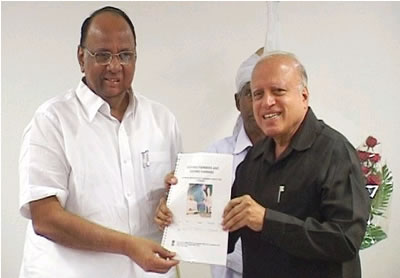
The National Commission on Farmers headed by MS Swaminathan
has handed over its final report and revised draft National
Policy for Farmers to Union Agriculture Minister Sharad
Pawar on 4th Oct 2006 in New Delhi. A detailed blue print
for implementing this policy was also submitted in the
form of final report “Serving farmers and saving
farming: towards faster and more inclusive growth of
farmers’ welfare”.
The policy document calls for: enabling farmers to earn
a minimum net income; not divert prime farmland for non-agricultural
purposes like Special Economic Zones (SEZs), lower interest
rates for loans; establishment of a national bank for
farmers; setting up an Indian trade organization to procure
food grains at market price; and promotes conservation
farming in the heartland of the green revolution.
For further details visit: Revised Draft National Policy
for Farmers at http://krishakayog.gov.in/revdraft.pdf ;
the Commission’s final report at http://krishakayog.gov.in/5threp1.pdf or contact: b.choudhary@isaaa.org
INDIA,
2007-08 TO BE YEAR OF “MORE
CROP PER DROP OF WATER” MS Swaminathan presented this week the
report “More
Crop and Income Per Drop of Water” to the Union Water
Resources Minister Saifuddin Soz. Recommending that the
year 2007-08 be declared as the "Year of more crop
and income per drop of water”, Swaminathan suggested
various measures to enhance agricultural production and
farmers’ income. These include:
• Adoption of System of Rice Intensification
technologies (SRI), which require fewer seeds, less nursery
area, and
save water and labor while enhancing yield
• Introduction of Micro Irrigation technology, such as drip
and sprinkler irrigation
• Adoption of crop diversification schemes, to include with
high value crops with reduced water requirements
• Introduction of a weather based crop insurance protection
• Adequate support to farmers for marketing and to access
to market information.
Swaminathan also recommended the formation of Water Users
Associations and additional measures to improve the management
of ground water resources.
For more information visit: http://pib.nic.in/release/release.asp?relid=21113,
or contact Bhagirath Choudhary at: b.choudhary@isaaa.org
INDIA EXPERIENCING COTTON BOOM India is set to become the world’s second largest
cotton producer. It might yet displace the United States
and come next to China as the largest cotton producer. “A
quiet revolution in the country’s cotton sector” is
happening says Vikas Dhoot of the Indian Express, as cotton
production in 2006-07 is estimated by the Cotton Advisory
Board to be between 265-275 lakh bales.
Dhoot quotes 2006 figures from the US Cotton Market Monthly
Economic Letter showing that India has shown an increasing
percentage share of world cotton production. With the estimated
production for November 2006-07, India is expected to displace
the US.
Textile Ministry officials led by Minister Shankar Singh
Vaghela attributed the boom to the fact that 60 percent
of farmers with irrigation were using Bt cotton seeds.
States like Gujarat, Punjab, Tamil Nadu had 50 percent
increase in yields due to better productivity.
Dhoot’s
article can be accessed at http://www.indianexpress.com/story/13925.html
SCIENTISTS
RECRUIT WEEVILS FOR HELP AGAINST FOREST WEED
A
plant introduced as an ornamental shrub has now become
one
of the biggest weed problems in New Zealand forestry.
Buddleia (Buddleja davidii), a woody species with attractive
purple flowers, is an aggressive weed that has the
capacity to out-compete young trees, making it a serious
problem
to forest owners.
Ensis
Forest Biosecurity and Protection (FBP) researchers in
Rotorua identified a leaf-eating
Chinese weevil
Cleopus japonicus ten years ago as a natural enemy
of buddleia.
Cleopus was released last month into Rotorua’s
Whakarewarewa Forest after a long and rigorous process
to screen the
insect’s diet to ensure it does not have an appetite
for native or beneficial species. Effective biocontrol
practices would mean cost-savings to the forest industry,
and a decrease in the amount of chemical herbicides
required to control buddleia. For more information, read the complete media release
at http://www.ensisjv.com/NewsEventsandPublications/
MediaReleases/tabid/140/Default.aspx?Module460_selectById=1427
EUROPE CLOSER COLLAB BETWEEN EFSA, MEMBERS STATES
The
European Food Safety Authority (EFSA) Advisory
Forum members signed this week a ‘Declaration of Intent’ confirming
their commitment to strengthen scientific co-operation
and information exchange on risk assessment between EFSA
and Member States of European Union. Members discussed possible opportunities to strengthen
collaboration including: identifying more formalized channels
of communications; sharing data on specific dossiers; setting
up ad hoc liaison groups on forthcoming risk assessments;
encouraging exchange of information between scientific
staff of EFSA and scientific panels at national level;
and sharing draft opinions under embargo on issues of particular
importance.
Catherine
Geslain-Lanéelle, Executive Director
of EFSA, welcomed this initiative: “I am pleased
that members of the Advisory Forum have signed up to meet
this new challenge. One of the key objectives in establishing
EFSA was to achieve greater coherence in risk assessment
in the EU. EFSA aims to deliver the best science at the
right time and in the most appropriate manner. This can
only be achieved through effective pooling and leverage
at European level of our collective resources and expertise
in risk assessment and risk communications.”
Read
the full press release at http://www.efsa.europa.eu/en/press_room/
press_release/adisory_forum_decl_intent.html
A SIMPLER CAP FOR EUROPE Experts from Europe gathered this week
for a two-day conference in Brussels aimed at simplifying
the Common Agricultural
Policy (CAP). “Our objective is to eliminate excessive
bureaucracy in the Common Agricultural Policy,” said
Enterprise and Industry Commissioner Günter Verheugen,
one of the keynote speakers in the conference. Simplification
efforts focus on both technical and policy aspects. The
European Commission is planning in December to draft a
proposal for a single Common Market Organisation (CMO)
to replace the 21 CMOs that currently cover the different
agricultural markets. This move will increase transparency,
improve the quality of legal texts and reduce costs for
national administrations and companies.
Access the press release at http://europa.eu.int/rapid/pressReleasesAction.do?reference=IP/
06/1296&format=HTML&aged=0&language=EN&guiLanguage=en.
SPIDER
VENOM TOXIN – A NEW LINE OF DEFENSE FOR PLANTS? Spider venoms are a complex blend of toxins that have
evolved specifically to kill insects. One such toxin from
the venom of the Australian funnel web spider (Hadronyche
versuta), Hvt, kills preys by blocking the flow of calcium
in the cells of invertebrates impairing important cellular
functions. This small, stable peptide works with amazing
specificity: it affects only certain classes of insects,
many of which are known agricultural pests. Scientists
at the National Institute for Biotechnology and Genetic
Engineering (NIBGE) in Pakistan are now studying the potential
of the spider toxin in protecting plants from insect attack.
In an article published in a recent issue of Transgenic
Research, the researchers reported that the purified toxin
fusion from engineered E. coli immobilized and killed the
larvae of two herbivorous insect pests, cotton bollworm
and the Egyptian armyworm, when applied externally. Transgenic
expression of Hvt in tobacco plants also protects the plants
from caterpillars, killing all the larvae within 48 hours.
The effects of the toxin were sufficiently rapid to prevent
significant damage to the leaves.
The researchers plan to introduce the gene into cotton
to determine the suitability of spider venom-derived toxins
for agricultural application. However, since the issues
on biosafety need to be addressed, it will take some time
before these toxins find a new host in plants.
The complete article “Spider venom toxin protects
plants from insect attack” can be viewed at http://dx.doi.org/10.1007/s11248-006-0007-2.
The abstract is available at http://www.springerlink.com/content/67114104784q55n3/
?p=fb961b74b3394b1ebd160af2d0422a96&pi=7.
ARTICLE REVIEWS DNA DETECTION IN GM FOODS Karl-Heinz Engela and colleagues from research
institutions in Germany review methods and challenges
of “Quantification
of DNA from genetically modified organisms in composite
and processed foods” in a recent issue of Trends
in Food Science and Technology. Legislation in the European
Union requires certain thresholds for the presence of materials
derived from genetically modified organisms (GMO). Testing
for GM presence is therefore important to meet trade requirements
for certain countries.
Researchers report that: 1) Differences in particle sizes
of components of food products can lead to over and underestimation
of GMO contents; 2) Qualitative assays demonstrated that
longer target sequences become increasingly susceptible
to degradation, resulting in false negative results when
analyzing samples of processed foods or feeds; 3) New methods
of quantification, such as ligation-dependent probe amplification
(LPA) and microarray technology, should be used so that
the effects of food composition and processing can be ruled
out; and 4) Quantitative screening assays can be used in
combination with synthetic quantification standards to
gain important information about the compositions of samples. Subscribers to the journal can read the complete article
at http://dx.doi.org/10.1016/j.tifs.2006.04.008.
SURVEY:
E-AGRICULTURE FOR SUSTAINABLE DEVELOPMENT The Food and Agriculture Organization (FAO) is conducting
a world-wide survey to determine the role and impact of
Information and Communication Technologies (ICT) in agriculture,
for the promotion of sustainable development. Results from
survey will help better to define the role that digital
technologies can have in improving information exchange
and communication related to agriculture.
The survey may be completed in English, Spanish or French
at:
http://www.fao.org/rdd/eagsurvey/index_eag.asp?lang=en&ref=
INTERNATIONAL CONFERENCE ON GRAINS POST-HARVEST TECH SLATED
The Indian Society of Agricultural Biochemists (ISAB)
and C. S. Azad University of Agriculture and Technology,
Kanpur are jointly organizing an International Conference
on Post-Harvest Technology and Value Addition in Cereals,
Pulses and Oilseeds (ICPHT-2006) during November 27-30,
2006 in Kanpur, India.
The event aims to improve the post-harvest operations
in crops and develop food products with better nutritional
quality.
For detail information contact Dr P.S. Kendurkar at pskendurkar@yahoo.co.in.
Visit the conference homepage at: http://csauk.ac.in/post-harvest-technology-confrence.html
AUSTRALIA HOSTS WOOD CONFERENCE
The
International Academy of Wood Science (IAWS) 2006 Conference, “Wood Science and Technology in 2100”,
will be held in Melbourne 13-16 November. The conference
will cover topics such as the effects of wood production
on climate and vice-versa, energy from wood, new commercial
plantation species for wood production, genetic selection
for wood quality improvement, and chemical manufacture
and storage in trees. Read more at: http://www.csiro.au/csiro/content/standard/ps2ce,,.html and
http://www.ensisjv.com/NewsEventsandPublications/EventsandSponsorship/
IAWSAccommodationandVenue/tabid/163/Default.aspx
E-LEARNING MASTER IN BIOSAFETY IN PLANT BIOTECHNOLOGY The Università Politecnica delle
Marche, Italy, is offering a 12-month E-learning master
in Biosafety in
Plant Biotechnology based on a combination of distance-learning
and on-campus training sessions. The course is distinctively
interdisciplinary with students and faculty from natural
and social sciences, and it leads to an accredited diploma.
The program is supported by the United Nations Industrial
Development Organization (UNIDO). Deadline for submission
of applications is 31 October 2006.
For further details visit: http://193.205.134.131/Entra/Engine/RAServePG.php/
P/3374110800/M/3276110807 or contact Prof. Bruno Mezzetti at b.mezzetti@univpm.it.
ILRI RECRUITING A BIOSCIENCES RESEARCH SUPPORT SCIENTIST The Africa-based, globally networked International Livestock
Research Institute (ILRI) is seeking to recruit a Biosciences
Research Support Scientist to facilitate capacity building
through strategic planning, technical coordination, implementation
and monitoring of research projects within the Biosciences
eastern and central Africa (BecA), a new center for excellence
in modern biology in Africa hosted by ILRI. The position
will be based in Nairobi, Kenya.
For
further details and requirements write to recruit-ilri@cgiar.org (quoting
Ref: BRSS/T4/10/2006) or visit http://www.biosciencesafrica.org and http://www.ilri.org.
|


