

Scientists Develop First Autoluminescent Plants that Light Up Under Attack
March 25, 2026| |
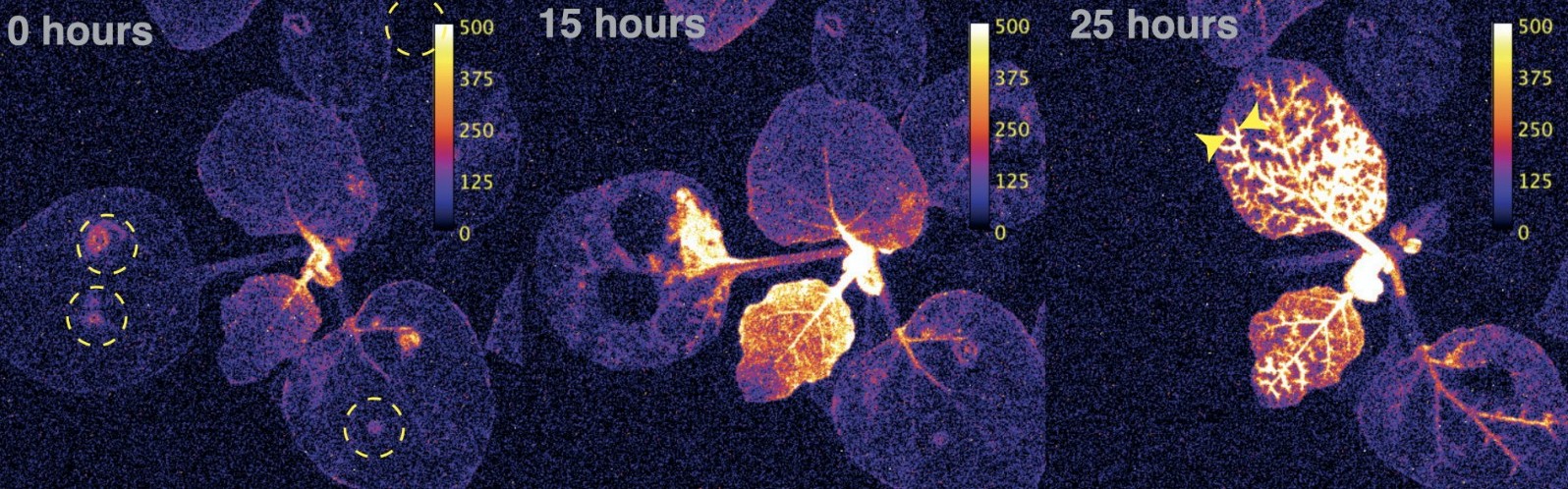
Scientists have developed a way to visualize plant stress by engineering crops that light up when they are under attack. Using advanced biosensors, researchers at the MRC Laboratory of Medical Sciences (LMS), the Institute of Experimental Botany of the Czech Academy of Sciences, and the biotech startup Planta have created the first autoluminescent plants that emit a fluorescent glow when they experience physical damage or herbivore threats. This bioluminescence is triggered by a rapid wave of calcium signaling that travels from the site of injury to the rest of the plant, acting as a high-speed SOS signal to activate defense genes.
The technology allows researchers to observe, for the first time in real-time, how plants communicate internally to survive environmental pressures. When a leaf is bitten by an insect, the engineered biosensor detects a surge of glutamate, a neurotransmitter also found in animals, which then initiates a calcium wave. This sophisticated monitoring system provides a visual map of a plant's nervous-system-like response, moving at a speed of approximately one millimeter per second to alert distant leaves of the impending danger.
This innovation holds significant potential for the future of sustainable agriculture and global food security. By understanding the precise triggers and pathways of plant stress, scientists can develop hardier crop varieties that are better equipped to withstand pests and climate-related challenges without the heavy reliance on chemical pesticides. As technology evolves, it could lead to "smart crops" that provide farmers with early warnings of infestations or dehydration long before visible symptoms appear, helping ensure more resilient food systems.
For more details, read the article on the LMS website.
| |
You might also like:
- Sunlight-Recharged Glow-in-the-dark Succulents New Way to Plant-based Lighting Systems
- Bioluminescent Petunia to Light Gardens and Homes at Night
- Brightest Engineered Plants Glow Throughout Life Cycle
Biotech Updates is a weekly newsletter of ISAAA, a not-for-profit organization. It is distributed for free to over 22,000 subscribers worldwide to inform them about the key developments in biosciences, especially in biotechnology. Your support will help us in our mission to feed the world with knowledge. You can help by donating as little as $10.
-
See more articles:
-
Plant
- Genetic Breakthrough Could Triple Wheat Yields and Boost Global Food Security
- Study Reveals Mixed Public Attitudes Toward GMOs in Kenya
- Engineered Sugarcane Shows Improved Tolerance to Glyphosate
- NCBP Reviews Public Information and Transparency of Biosafety Framework with Media and Scicom Experts
- Developing Nations Drive Global GM Crop Growth - ISAAA
- Rothamsted's Gene-Edited Barley Becomes First Crop to Receive the UK's Precision Bred Organism Marketing Notice
- Scientists Develop First Autoluminescent Plants that Light Up Under Attack
-
Environment
- Cornell University Scientists Engineer Bacteria to Detect Arsenic Exposure
-
Read the latest: - Biotech Updates (August 5, 2026)
- Gene Editing Supplement (July 29, 2026)
- Gene Drive Supplement (February 22, 2023)
-
Subscribe to BU: - Share
- Tweet